
Office Building Roofing in Peoria, AZ
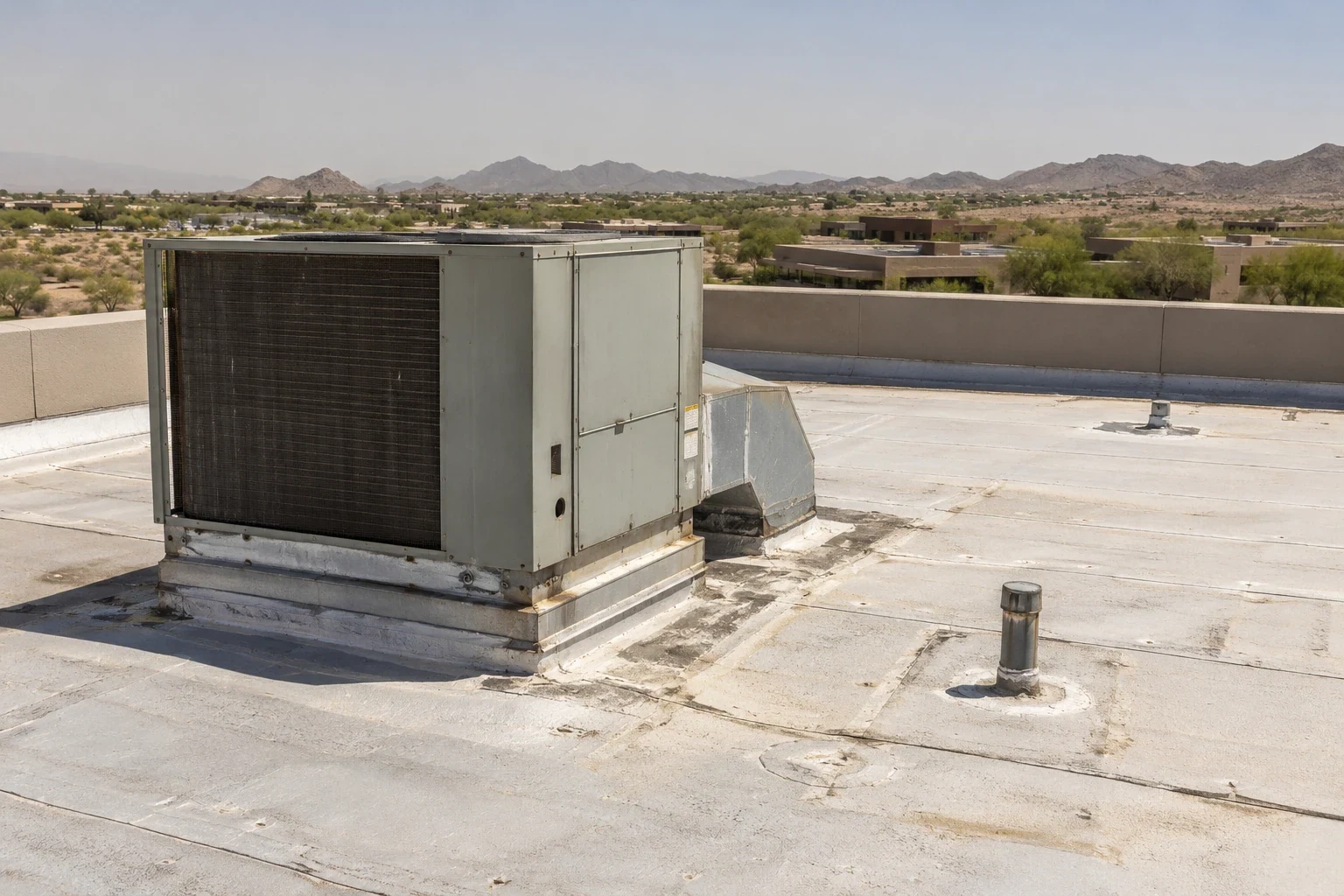
Rooftop units that have been replaced three times can leave an office roof with more openings than membrane. Each swap added a curb, a patch or a new line set, and each left a detail that now behaves differently from the sheet around it. In Peoria, AZ, long hot periods flex those details every day, and monsoon wind and short, heavy rain test them in a single afternoon. The question for an owner is not whether the roof needs replacement this year. It is whether the repair history, the leak pattern and the lease calendar support waiting, and what evidence would change that answer. We build that evidence first, then present the choices.
Count the openings left by past equipment changes
We start with a plan of every penetration: units, curbs, vents, conduit, antennas and abandoned supports. Each is marked for condition, age and whether it still serves a purpose. Abandoned penetrations are common on office roofs, and they are the cheapest leaks to eliminate.
Clusters matter most. Where several curbs share a patched area, the flashing is often a layered record of earlier repairs. A curb and support rebuild during the next equipment change can replace that history with one clean detail. We give the owner a list of openings to retire, to rebuild and to leave, with an estimate of how each choice affects the leak risk and the replacement timeline.
Condensate lines deserve a look too. A line that discharges onto the membrane wears a stain and a thin spot, and over time the sheet fails at that exact point. Routing the line to a drain or pad is a small change with a long payoff.
Read parapet and wall details for slow leaks
Many office roofs end at parapet walls, and the wall base is where a quiet leak starts. Counterflashing may have pulled away, coping joints may have opened, and stucco or masonry above the flashing may have cracked. Water enters slowly and shows up inside as a faint stain that returns after each storm.
We check wall flashing height, termination bars, sealant and coping. Where the edge shows movement, we review edge metal and coping as a separate item, since a loose cap can admit water even when the field membrane is sound. Photographs of each wall section go into the record, so later visits can compare conditions.
Skylights and light wells, where they exist, add their own flashing and glazing seals. The age of the sealant often explains a stain near a lobby or atrium better than the membrane does.
Compare repair history with lease obligations
On a multi-tenant office property, who pays for the roof depends on the lease. Some leases pass costs through to tenants, and some leave the owner responsible. The timing of a replacement can change who benefits and who pays, and an owner who understands that can plan accordingly.
We assemble the roof history, the leak log and the lease calendar into a single view. The result is a set of options with timing and cost shown side by side: continue repairs for a defined period, plan an early replacement or stage the work in sections. That capital planning summary helps a property manager present the case to ownership with facts in hand.
The cost of waiting should also be on the table. If a roof will need replacement within a few years regardless, spending on extensive repairs now may be money better kept for the replacement, and the plan should say which repairs are only holding actions.
Schedule noisy work around tenant hours
Office tenants notice noise, dust and odor quickly. Tear-off above an occupied suite is the hardest phase, since fasteners, hammering and vibration carry through the structure. We ask each tenant about meetings, calls and deadlines, then place the loudest tasks in the quiet hours and the quietest tasks in the busy ones.
Work on an occupied building is phased by roof section, with advance notice to every tenant and a contact for questions. Parking and staging areas are laid out so employees and visitors have a clear entrance. When weather is unsettled, sections stay small enough to close within the day.
Security and access rules for tenants with sensitive operations may apply to roof crews. We ask early about badge requirements, escorts and restricted floors so the schedule reflects them.
Weigh reflective surfaces against the cooling load
A Phoenix summer keeps the air above 100 degrees for months, and a dark roof on an air-conditioned building adds heat that the cooling system must remove. A reflective surface can reduce the load, though the benefit depends on insulation, equipment and hours of use.
We describe the likely effect in general terms and compare membranes by durability, repairability and cost. The right choice for an office is the one that performs under foot traffic from service technicians, resists the heat cycle and can be repaired easily in the future. Sometimes that is a white single-ply, and sometimes a coating over a sound existing roof.
Equipment replacement is a good moment to improve the surface under and around units. Walk pads, new curbs and a fresh cap sheet can be installed while the unit is out, avoiding a second visit and a second set of seams.
Treat business parks as a portfolio
The city's development map lists several Arrowhead business park and commerce park records, which indicates a broad cluster of commercial properties and not one building. Owners with several buildings in the Arrowhead business park district or downtown and Old Town Peoria can use one record format for all of them. A medical office in the same portfolio can be compared against the same threshold, with adjustments for its interior use, and a suite that houses server rooms follows the stricter consequence ranking used for a data center.
The format can also carry the warranty file, so any coverage that remains is tracked next to the repair log and the replacement horizon.
Commercial Roofing Questions
When should an office owner replace rooftop equipment curbs instead of patching them?
Replace them when the flashing has been patched repeatedly, when the curb is damaged or when equipment is being changed anyway. A new curb with prefabricated flashing resets the detail and removes a source of future repairs. The decision is coordinated with the mechanical contractor.
How should a property manager handle a leak that returns after each storm?
Document the dates, weather and interior location, then have the roof section traced. A returning leak means the earlier repair did not reach the entry point. We trace the path, check nearby details and propose a defined boundary for the next repair.
Who pays for a roof replacement in a multi-tenant office building?
The lease decides. Some pass part of the cost through to tenants and some do not. We provide a clear scope and cost breakdown, and the owner or manager applies the lease terms. Knowing the timing in advance helps with budgeting and tenant communication.
Can an office roof be replaced while tenants stay?
Yes, in most cases. The work is phased, notices go out in advance and noisy tasks are scheduled for quieter hours. Interior protection is added where needed. A contact person is named so tenants can ask questions or report concerns.
Does a reflective roof always lower cooling costs?
Not always by a large amount. The effect depends on insulation, equipment efficiency and building use. It generally reduces roof surface temperature and heat entering the space. We describe it as one factor in a membrane decision, not a promise of a specific saving.