Commercial Roofing in Avondale, AZ
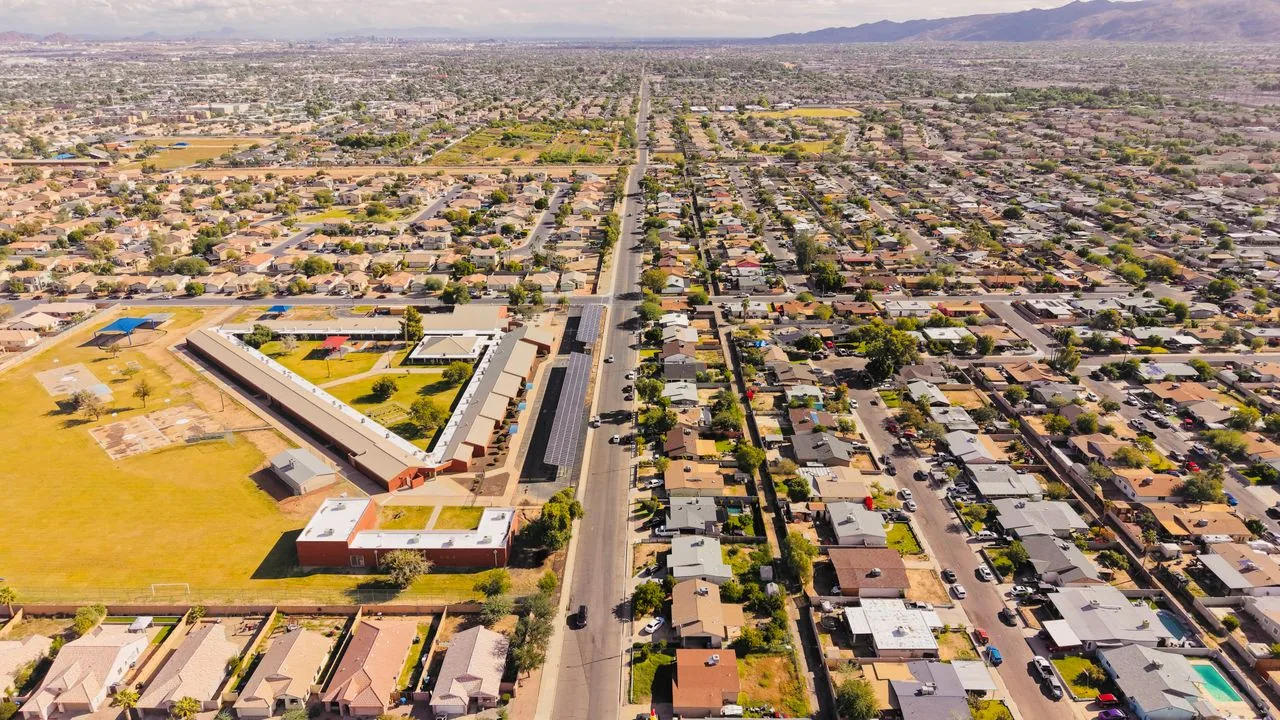
Ponding water behind a parapet will distort a replacement budget before anyone sees a leak. The membrane stays intact, the interior stays dry, and the roof is quietly carrying a load it was never meant to carry, while the water softens seams and breeds a slow failure at the lowest corner. Avondale has about 48 square miles of land and reported roughly $3 billion in retail sales for 2022, so an owner here is often managing storefront and service roofs where drainage and rooftop equipment decide the service life. We travel from our base in Peoria, AZ, about 33 miles in a straight line, and we start with water: where it goes, where it stops, and what the stopped water has already done.
Trace the water path to every outlet
A flat commercial roof is only as sound as its slowest-draining low point. On the first walk we follow each slope to its drain or scupper, note any standing water that remains a day after rain, and mark the spot against the plan. Debris, a crushed drain bowl or a scupper set an inch too high can hold water for hours, and a sustained load on the deck shortens the life of every seam beneath it.
The fix may be as small as clearing and resetting a drain or scupper, or as involved as tapered insulation that gives the roof a real fall. We state which one the building needs and why, with photographs of the ponding, so the owner can weigh a modest repair against a larger scope with the evidence in hand.
Ponding also changes how a coating or new membrane should be specified. Standing water accelerates algae, dirt and ultraviolet breakdown on the surface, and it can void the assumptions behind a coating system. If the low spot is structural, we say so before a coating is priced, and we offer a tapered insulation layer or an added drain as the alternative. After the work is complete, a rain check confirms that the water now leaves the roof within a reasonable time and the photographs go into the asset record.
Count the penetrations on a storefront roof
A retail or service building collects rooftop equipment over time: package units for each tenant, exhaust fans, vents, conduit and the occasional satellite mount. Each one is a hole in the membrane with a curb, a boot or a patch of sealant around it, and each one moves differently under heat. We count them, number them on a sketch and probe the termination at every one.
A cluster of failures near a single tenant's equipment usually has a simple cause, such as a fan that was relocated without reflashing. We separate those local problems from a general loss of membrane condition. The curb and equipment support findings go into the roof record, so a mechanical contractor working up there next year knows what to protect and what to call us about.
Compare recover, restoration and tear-off
Three routes reach most Avondale-sized owners once a roof ages out of simple repair. A recover installs a new membrane over the old one when the insulation is dry and the existing system can carry the added layer. A restoration coating suits a bonded, dry membrane that still has life in it. A tear-off removes everything to the deck and is the answer when moisture has spread through the insulation or earlier recovers have already been stacked.
The moisture survey chooses among them. Where the readings stay low, a roof recover can defer the largest spend and keep the building occupied with less disruption. Where wet insulation turns up in several places, covering it only hides the damage. We present each route with its condition requirements and its likely planning window, then let the owner decide with the numbers visible.
Prepare edges for monsoon outflow
The National Weather Service ties Arizona monsoon storms to damaging winds and microbursts, and those winds find the perimeter first. Edge metal that has lost fasteners, a coping cap that has loosened and a membrane that has pulled away at the parapet corner are small defects before a storm and large ones after it. Phoenix-area records show about 94 days a year with highs at or above 100 degrees, and the heat softens the sealants that hold those edges in place.
Before the season, we check the perimeter for loose metal, open laps and lifting terminations, and we tighten or replace what has moved. The work on edge metal and coping is inexpensive next to the interior damage it prevents. After a storm, a second walk looks for lifted flashings and wind-driven debris that scratched the membrane.
Choose the capital window with the lease calendar
Timing a roof project is partly a roofing question and partly a lease question. A tenant with several years left expects the roof to hold, and an owner preparing a sale wants the condition documented. We build a short timeline for each building that sets the roof's remaining service life against the lease dates and the owner's own budget cycle.
For owners who also hold space near Goodyear or in Phoenix, the same method scales across the group, and a documented roof condition report for each building makes the comparison fair. Jurisdictions set their own permit and code rules, and Peoria, for one, adopts the 2018 International Building Code as amended locally, so we confirm what applies to a project before we price it.
Commercial Roofing Questions
A retail roof in Avondale holds water after rain. Is that a repair or a design problem?
Both are possible, and the survey separates them. Water that stands near a drain often comes from a blocked or sunken outlet, which is a repair. Water that stands in the middle of a bay usually points to deck deflection or too little slope, which needs tapered insulation or a larger scope. We measure the depth, mark the area and tell you which category the roof falls into.
What is the practical difference between a roof recover and a tear-off?
A recover leaves the existing roof in place and adds a new membrane over it, which cuts disposal and downtime. A tear-off removes the old system to the deck. The recover is only sound when the old insulation tests dry and the structure can carry the extra layer. If either test fails, the tear-off is the sound route, and we show the readings that led there.
Do rooftop units from different tenants affect how the roof ages?
They do. Each unit adds a curb, a set of lines and foot traffic from service technicians, and all three wear the membrane around them. We map the units, protect the walking routes with pads where traffic is heavy, and fix the flashing at any curb that has opened. A tenant's equipment change is a good moment to recheck the whole cluster.
How should an owner plan around summer heat when scheduling roof work?
Adhesives and sealants behave differently on a roof surface that has baked all afternoon, so we start early and finish seams before the surface gets hot. Large projects are sequenced section by section, and the open area is closed at the end of each day. Scheduling a replacement in cooler months is helpful but rarely essential.
Who documents the roof if an insurance claim follows a monsoon storm?
We do. Photographs, a marked roof plan and a written description of the damage, separated from age-related wear, go into the claim file, and we walk the carrier's adjuster through the findings on the roof. If the storm is only part of the problem, the report says so, which keeps the claim and the maintenance plan from being confused.