
Distribution Center Roofing in Peoria, AZ
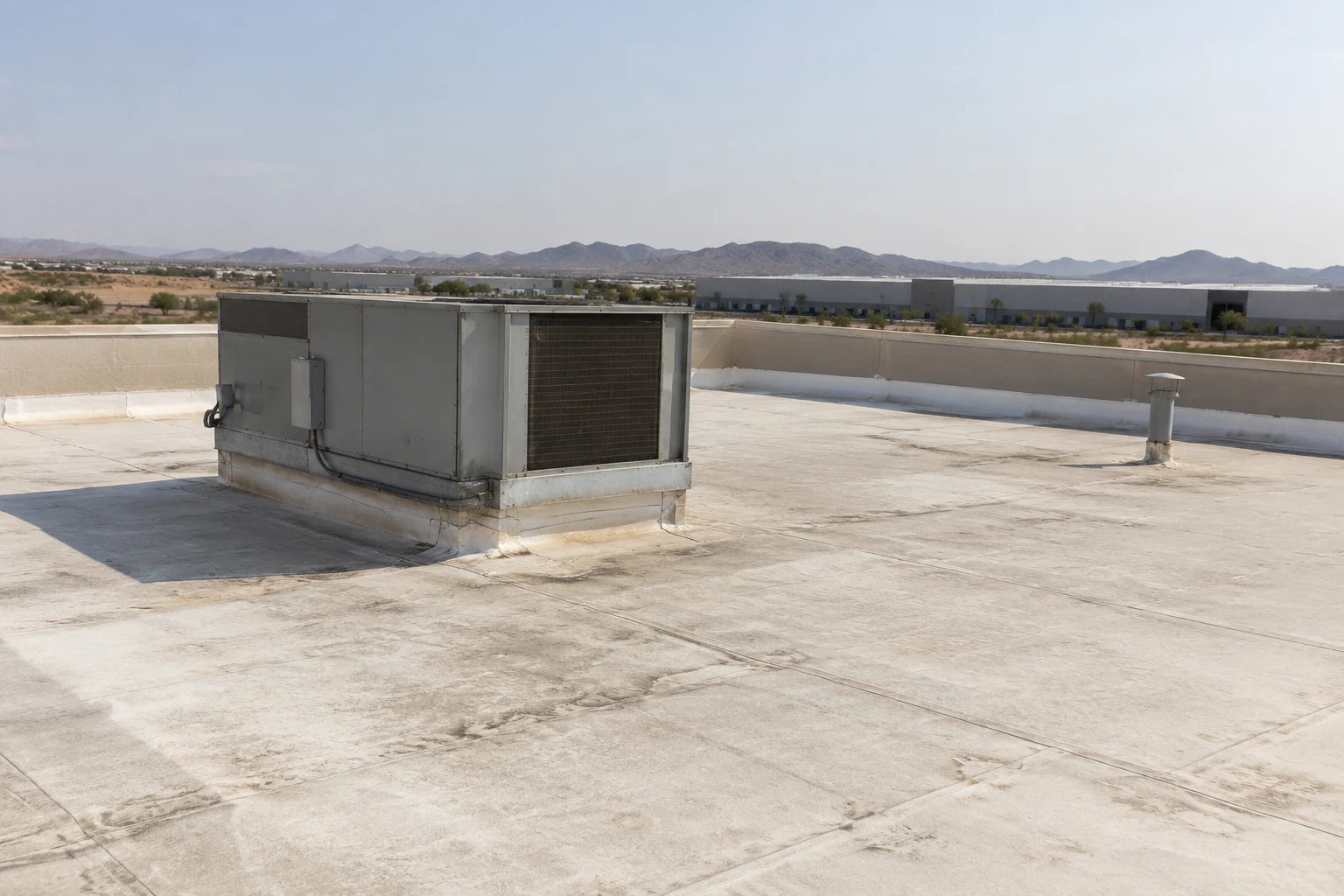
A cluster of rooftop penetrations can age a distribution roof faster than the open membrane around it. Exhaust fans, smoke vents, conduit supports and mechanical curbs each interrupt the sheet, and each depends on a hand-made seal that moves with every heat cycle. In Peoria, AZ, the City reports about 114 million dollars in 2022 transportation and warehousing receipts, a regional signal of logistics activity rather than a count of roofs. For an owner, the practical question is simpler: which details are failing, which are next, and how much of the roof history supports waiting. We answer it with a map of the penetrations, the drains and the seams, and a written boundary for each repair.
Map every curb cluster before choosing a repair
On a distribution roof the leak is often at a cluster, not at a single opening. Three fans and a smoke vent within a few feet of each other share flashing, sealant and sometimes a patched membrane, so one failure can feed water into several details. We photograph each cluster, probe the flashing and mark which seals are original and which were added later.
The map shows where repairs have stacked up. A cluster with four generations of sealant is not a candidate for a fifth coat. It is a candidate for rebuilt curbs and new flashing, ideally done as part of a larger scope. Work on rooftop equipment curbs and supports is often the most cost-effective upgrade on a roof that is otherwise sound.
Smoke vents and roof hatches belong on the same map. Their gaskets harden, their curbs corrode at the corners, and a hatch left unlatched in a gust can bend its frame. Each one is small, but each is a path for water into the building.
Account for heat cycles on dark surfaces and metal trim
Triple-digit air temperatures stretch across most of a Phoenix summer, and roof surfaces run hotter still, which is why membrane, sealant and edge metal all move hard. Metal trim expands and contracts faster than the sheet it holds, which opens joints and loosens fasteners over time.
We check edge metal, cleats and coping for movement and look for membrane that has pulled back from its termination. Where the surface is sound but weathered, a cool roof surface can lower the thermal stress on the system, and the benefit shows in the heat-cycle range the roof sees each day.
Walk pads between units matter more than they seem. Technicians cross the same route every month, and a worn path in the membrane often becomes the first leak on an otherwise healthy roof.
Prepare drains and edges for monsoon exposure
The National Weather Service names damaging winds, hail and flash flooding as possible monsoon impacts in the Phoenix metro area. Large buildings with long roof runs concentrate water at a few outlets, so a blocked drain has a larger effect than on a small roof. Wind that rakes along the perimeter tests edge metal and corner details.
Before the season we clear drains and check overflow routes, tighten loose metal and look for ponding that has persisted from earlier storms. Once the storm passes, a second walk sets the roof against the photographs taken before it. A wind damage repair that starts from a recorded baseline is easier to scope and easier to document for an insurer.
Temporary protection goes in when a storm exposes a damaged section. Tarps are fastened through battens, not weighted, since gusts can lift loose covers and turn them into a hazard for the whole roof.
Sequence work around dock schedules and inventory
A fulfillment building runs on tight cycles. Trucks arrive in waves, inventory moves between racks and the dock, and a delay at one door ripples through the building. Roofing work has to fit that rhythm. We ask for the busiest hours, the doors that must stay clear and the interior zones where water or dust would do the most harm.
Roof sections are opened one at a time and closed the same day. Material staging is placed away from truck courts, and a spotter watches the ground below. Loop 303 is the main planned employment-growth spine through north Peoria, yet the access plan for any one building is set by that building alone: its docks, its truck courts and its shifts.
Fire alarm and sprinkler zones deserve a note in the plan as well. If work near a detector could trigger a false alarm, the building team knows in advance and can notify the monitoring company.
Set the repair-versus-replacement line in writing
Owners deserve a rule they can apply every year. We write it as conditions: the share of wet insulation, the number of leaks in a season, the condition of seams and the expected service life. When a roof crosses the line, the plan moves from repair to a scoped replacement. Until then, repairs are limited to defined boundaries.
The line also names the cost of waiting. A season of leaks over racking can cost more than the repair that would have stopped them. For comparison, a warehouse roof with fewer penetrations may carry more risk from drains than from curbs, which is why each building gets its own threshold.
Each year the line is checked against new evidence. If the moisture map has not changed and no new leaks appeared, the roof stays on its repair path. If either has shifted, the planning window moves forward with the data to support it.
Keep an asset record that survives tenant changes
Buildings change tenants and owners, and the roof should not lose its history each time. The asset record travels with the building: survey results, repair history, photographs, warranty file and capital timing. A new tenant or owner can read it in an hour and know the state of the roof. An owner who also holds a manufacturing plant can review both records together for a single portfolio view. Owners with sites in Glendale or Surprise can place them in the same format.
Commercial Roofing Questions
When should a distribution center rebuild its rooftop curbs instead of resealing them?
Rebuild when the flashing has been resealed more than once, when the curb itself is damaged or when several curbs leak in the same season. Resealing treats the symptom for a short time. Rebuilding changes the detail and can be coordinated with the mechanical trade to avoid a second visit.
How do you keep a fulfillment operation running during roof work?
We divide the roof into small sections, open one at a time and close it each day. Hoisting and staging stay away from active docks, and a spotter watches the ground. The operator names the doors and hours that matter most, and the plan is built from that list.
What does a good roof record show a new tenant or buyer?
Dated photographs, a map of repairs, moisture survey results, warranty status and an estimate of remaining service life by section. It lets the reader see what has been done and what is likely next, without relying on memory or a verbal summary.
Should dark membranes be coated for heat?
Only if the substrate is dry and the membrane is still bonded. A reflective coating can reduce surface temperature and slow wear, but it will not cure wet insulation or open seams. Testing comes first, and the result decides whether a coating belongs in the plan.
Is a post-storm walk necessary if no leaks appear?
It is a sound habit after strong monsoon winds or hail. Damage can sit in a seam or at an edge for weeks before water finds it. A walk with photographs documents the roof as it stands and gives a baseline if a claim is needed later.