
Commercial Roofing in the Loop 303 Employment Corridor, Peoria, AZ
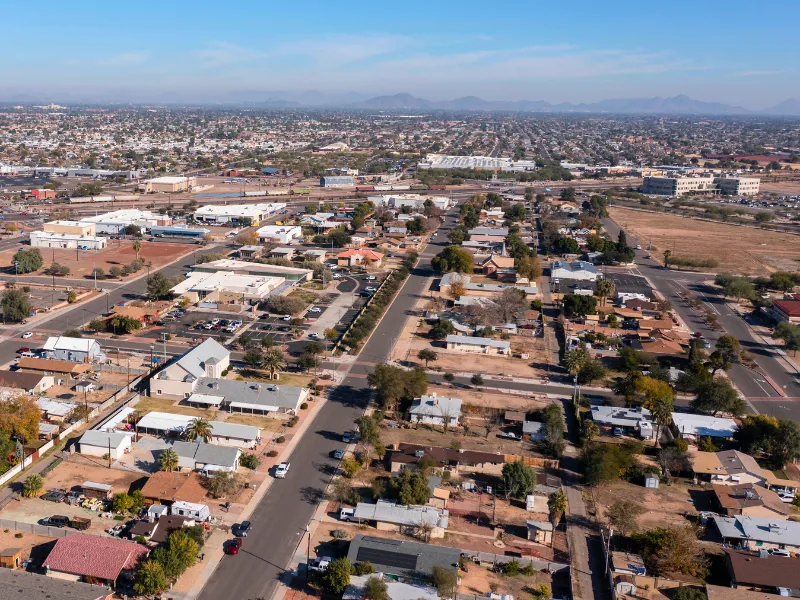
Along Loop 303, the roofs that matter most to an owner are usually the ones with the least history on file. A corridor planned for business park, industrial and community commercial use puts low-slope membranes, metal roofs and dense rooftop equipment into one stretch of Peoria, AZ, and each of them carries its own capital decision. We start with the roof history that exists, then walk the roof to see what the record is missing: seam condition, edge metal, curb clusters and the water path to each outlet. The result is a scope decision an owner can defend, whether that means a repair boundary, a coating, a recover or a planned commercial roof replacement.
Read the buildings the corridor was planned to hold
The city plan studied an area of roughly 18,300 acres spanning Peoria, Phoenix and Maricopa County, and its land-use table reserved 2,625 acres for business park or industrial purposes and 1,005 acres for community commercial in the 2005 snapshot. That table describes intent, not finished roofs, so we do not assume a building type until we are standing on it. What the mix does tell an owner is which roof questions tend to arrive together: large low-slope fields with many penetrations on the employment side, and retail pads with parapets, scuppers and storefront canopies on the commercial side.
On a first walk we sort the roof by what it carries. A field with several rooftop units has a different failure pattern than a clean membrane with a few drains, and the repair boundary follows that pattern. A flex industrial roof that houses office buildout under a warehouse bay, for example, often shows trouble first at the unit curbs and the sheet-to-wall transition, not in the open field.
Plan access at each interchange before mobilizing
The corridor links Happy Valley Parkway, Lone Mountain and Dynamite Parkway, and Lake Pleasant Parkway through service interchanges, which shapes how material trucks, lifts and a tear-off crew reach a site. We confirm the truck route, the staging footprint and the hoisting plan before a start date goes on the calendar, because a roof can be sound in design and still lose days to a staging problem on the ground.
Occupied buildings add a second layer. An employer running shifts under a roof wants noisy tear-off sections closed by a set hour and loading areas kept clear for deliveries. We divide the roof into areas that can be opened and dried in within a working day, and we hold the fastening and flashing details for the end of each section so a late-afternoon monsoon cell does not meet an open edge. That sequencing is the practical content of occupied building reroofing, and it is written into the schedule rather than promised in conversation.
Weigh heat cycles against monsoon exposure
In a typical year Phoenix logs about 94 days at or above 100 degrees Fahrenheit, an air-temperature record for the region rather than a reading taken off any roof here. The point for an owner is the repeated expansion and contraction that long hot periods put on membrane seams, perimeter metal and sealant at penetrations. We look for open lap edges, chalked or crazed surfaces, sealant that has split, and metal that has walked away from its fasteners.
Monsoon storms then test whatever the heat has loosened. Arizona monsoon storms can bring microbursts, damaging wind, flash flooding and hail, according to the Weather Service, and the large hail of October 5, 2010 across the metro shows that a roof can take more than rain. After a storm we check wind damage at edges and flashings first, then drains and overflow openings, because a roof that cannot shed a short burst of rain fails at its low point.
Set the repair-versus-replacement threshold early
A building can change hands, tenants or rooftop equipment, so a roof decision is rarely made only once. We write the threshold down: how many failed transitions, how much wet insulation and how many repeat patches move a roof from repair to a recover or a full tear-off. An infrared moisture survey gives that line evidence, since it maps wet insulation that a surface walk cannot see and tells us whether a leak is local or spread across several areas.
If failures stay isolated, a targeted repair protects the current budget and preserves the replacement window. If they repeat across the roof, another patch only moves the decision forward without improving the record. We price both paths so the owner can compare a repair against a recover or replacement on the same page, and we say plainly which one the condition record supports.
Keep an asset record that survives the next owner
A newer roof can arrive with little paper behind it. We build the file as we work: dated photographs, a drain and curb map, the membrane type, the repair log and any warranty terms we can find. When a roof changes hands, that asset record shortens due diligence and keeps a buyer from guessing at service life. For an owner with more than one building, the same format lets a portfolio view compare roofs side by side, which is the idea behind written roof condition reports.
Neighboring planning areas follow the same logic. The Peoria Innovation Core and the North Peoria Gateway both sit along the same freeway, and an owner holding space in more than one of them can keep a single record format across properties.
Commercial Roofing Questions
How do I decide between patching and replacing a roof on a corridor building with an unknown history?
Start by establishing what the roof actually is. We confirm the membrane type, count the layers, and map any wet insulation, then compare the repair frequency against the area affected. A roof with isolated failures at a few curbs can be repaired and kept in service. A roof with wet insulation in separate areas, or the same seam failing after each patch, is signaling that the next capital window has arrived. We bring both a repair price and a replacement price so the comparison is on paper.
What does a first walk on a business park or industrial roof cover?
We walk the field, the perimeter and every penetration. That means seams, laps, flashing heights, coping and edge metal, drain bowls and strainers, scuppers, and the bases of each rooftop unit. We photograph what we find, note where water sits after rain, and check whether past repairs match the original membrane. You receive a written condition summary with findings ranked by consequence and timing rather than a single pass or fail.
Can a roof stay in service while a tear-off happens above an operating shift?
Yes, when the work is divided into sections that can be opened and sealed within a day. We coordinate crane or lift placement with your dock traffic, hold noisy work to agreed windows, and protect equipment and product below with temporary covers where the assembly requires them. If a concealed condition such as wet deck turns up, we stop at a defined decision point and tell you the added scope before continuing.
Which storm damage should I look for after a monsoon cell crosses the Valley?
Check the edges first: lifted coping, peeled flashing and displaced metal. Then look at drains, scuppers and any areas where water stayed standing, because short heavy rain exposes drainage weakness quickly. Hail leaves bruises or fractures on membrane and punctures on soft surfaces. Photograph everything with dates before cleanup, and call us so we can document the roof before temporary protection covers the evidence.
What records should I have ready when I call for a roof review?
Gather any prior inspection reports, invoices for repairs, warranty paperwork, and a note of where interior leaks appeared and when. If you do not have them, that is not a barrier: we reconstruct a working record from the roof itself. What the review needs to settle is the next decision, so tell us if the trigger is budgeting, a sale, a lease or a leak.