
Commercial Roof Replacement in Peoria, AZ
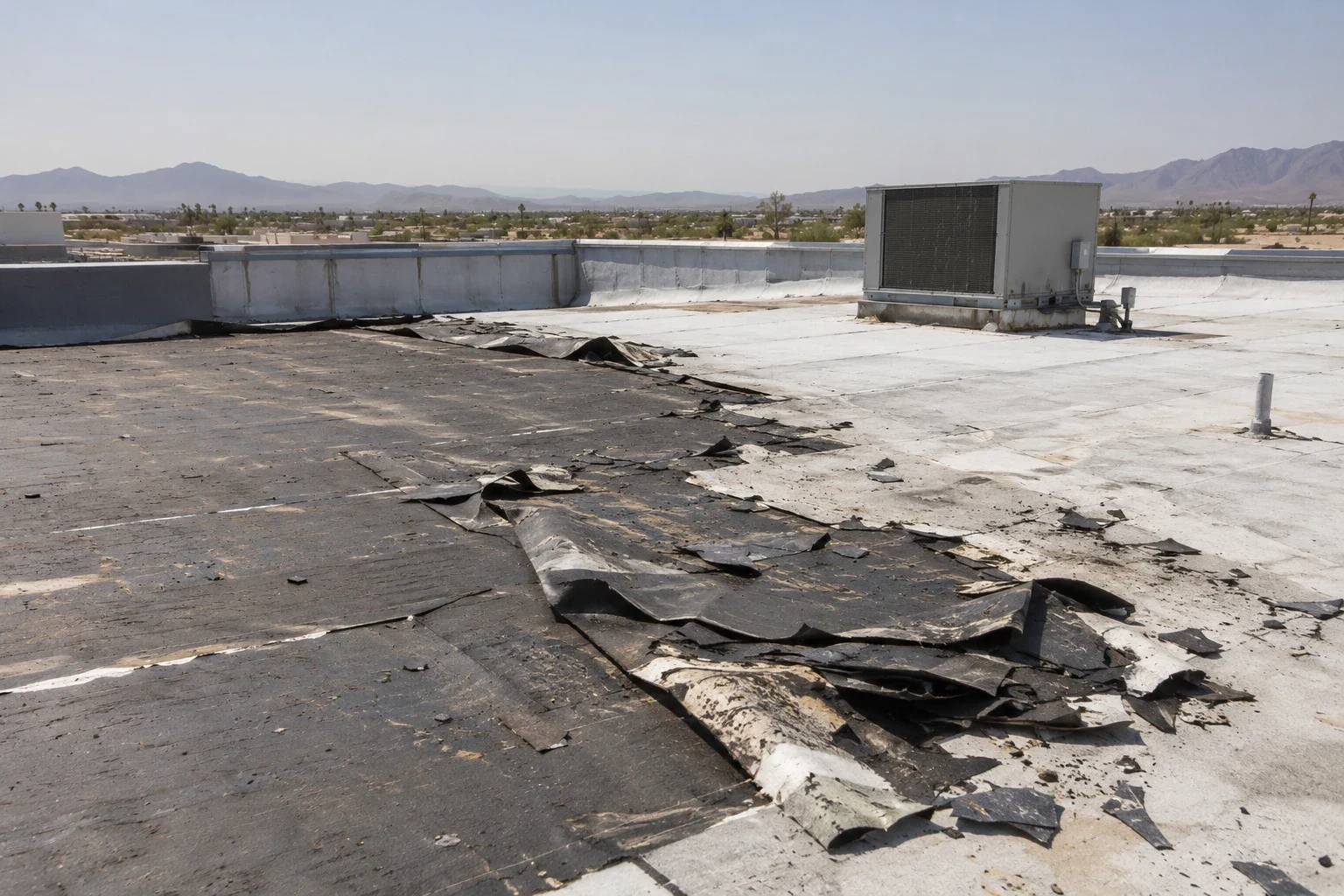
A replacement decision can hide inside a roof that still looks even from the parking lot. In Peoria, AZ, long heat exposure works on seams, perimeter details, and penetrations; a later monsoon burst or hail event can make a small weakness visible all at once. We compare repair history, moisture findings, drainage, and the remaining condition of the assembly before setting a replacement boundary. The question is whether another repair protects the asset or merely postpones a scope that has already spread. A hands-on commercial roof inspection gives the owner a record to use before approving tear-off, recover, or targeted work.
Find the failure pattern before approving tear-off
Repeated leaks near separate curbs, laps, or perimeter transitions can point to a broader system problem, while one damaged penetration may still be isolated. We map each report to its roof area, inspect the surface and details, and note whether water has reached insulation or deck. A single stain does not define the whole assembly. Nor does an old patch, by itself, establish that replacement is due. The useful evidence is repeated condition across zones and whether water returns after the same detail is corrected. Our commercial repair work can address contained failures while the owner compares a larger project window.
Record the conditions that change the scope
Before pricing a replacement, we check seams, flashings, edge metal, drains, scuppers, penetrations, rooftop equipment supports, insulation, and visible deck conditions. We photograph representative areas. Moisture readings can help identify suspected wet insulation, but their meaning depends on roof construction and weather; selected core cuts may be needed to confirm the assembly. We also review available warranty records, prior repair descriptions, and any known roof plans. This separates a coating, recover, or tear-off candidate without treating every surface variation as a failure.
On a roof with many HVAC curbs, conduit supports, or transitions, the details can consume more project time than the open field. We identify which equipment must remain in service, where a curb can be reworked, and whether the existing insulation or deck changes the replacement sequence. A roof insulation and cover-board review helps connect assembly condition to the planned thermal layer. For the owner, the resulting scope should show what is included, what remains, and what condition would trigger a change after tear-off.
Compare repair, recover, and full replacement
Repair makes sense when damage stays limited and the surrounding roof can support it. A recover may reduce disruption when the existing system is suitable, moisture is controlled, and code and manufacturer requirements permit another layer. Tear-off becomes more compelling when wet insulation is widespread, attachment has deteriorated, repeated repairs cross different roof areas, or the deck needs direct evaluation. We verify those conditions on the building. Our recover assessment checks those constraints before a second assembly is proposed.
Peoria adopts the 2018 International Building Code as amended locally. The International Energy Conservation Code also governs energy-efficient design in the city, and the edition in force is something the project team confirms with the permitting office during design. Assembly choice affects insulation, drainage, edge attachment, and transitions. We specify preparation, attachment, membrane, flashing, and closeout work. For portfolios near the Peoria Innovation Core, where planning contemplates employment and manufacturing uses, an owner may also need an approval sequence that fits capital planning rather than a single repair cycle.
Set a project window around building operations
Replacement timing is partly a roof question and partly an operating schedule. Tear-off exposes the building to weather until the new assembly is secured, so daily dry-in capacity and material staging matter. Recover work can reduce that exposure but only when the existing layers, moisture conditions, attachment, and applicable code allow it. We coordinate access and debris handling before work starts.
Heat changes how crews sequence adhesives and membrane work. Phoenix climate records show many days with high temperatures at or above 100°F, which is regional air-temperature context rather than a roof-surface reading. Scheduling accounts for hot surfaces and product limits. Near P83, staged work can maintain customer and delivery access while a section is open. If an urgent leak appears during the project, around-the-clock emergency response can stabilize the affected area and keep the replacement sequence moving.
Choose an assembly that fits the building
The replacement system should answer the building’s actual drainage, movement, exposure, and maintenance needs. A single-ply membrane can provide a clean field with welded seams, but curb geometry and perimeter attachment still need careful detailing. Modified bitumen and built-up systems use layered construction and require different sequencing. Metal roofs need attention to panel movement, fasteners, and transitions. Coatings can extend a suitable assembly when adhesion, moisture, and existing layers support that approach; coating is not a substitute for repairing a failed substrate. We compare compatible options for the property.
Where heat reduction is part of the owner’s operating goal, the decision should account for existing insulation, surface condition, drainage, and any energy-code requirements. A roof that ponds water needs drainage correction before a reflective surface becomes the headline. We use the actual assembly and owner priorities to recommend details. A TPO assembly, PVC membrane, or another system can be reviewed against that record.
Close the decision with a usable record
A replacement proposal should make the next approval easier, not bury the choice in material names. We lay out observed conditions, recommended work, repair alternatives where appropriate, and the reasons a recover or coating does or does not fit. The owner should be able to see which roof sections are included, how drains and equipment transitions will be handled, and what assumptions depend on concealed conditions. Photos and a written condition report give facilities and finance teams a shared basis for timing, especially when several buildings compete for the same capital window.
Our closeout records the installed work and the details that deserve future attention. Near Arrowhead Business Park or central Peoria, tenant schedules may shape the next inspection. The owner can compare later repair findings with the replacement record. A focused capital-planning review can connect that roof record to a portfolio decision.
Commercial Roofing Questions
What condition would make a recover a poor choice?
Widespread wet insulation, trapped moisture, unstable attachment, incompatible existing layers, or a deck concern can make another layer the wrong move. We verify the assembly with inspection and selective testing before recommending a recover. The deciding record should show the affected areas and why a tear-off is needed, rather than treating a surface age as proof.
How do you keep operations running during a replacement?
We plan the roof in work zones and coordinate access, noise, loading, and weather protection with the building contact. A retail property near Park West may need pedestrian routes kept clear, while a production facility may need a different delivery and shutdown window. We identify daily secure stopping points before tear-off begins and adjust the sequence if conditions change.
Will a leak history alone require a new roof?
A repair log is useful when it locates each leak and records what was corrected. Several unrelated entries can reveal a repeated system weakness, but recurring water at one detail may still be repairable. We compare those records with current moisture and assembly findings, then separate isolated work from conditions that justify a larger replacement scope.
Can the insulation package change during tear-off?
Concealed layers can differ from drawings or prior records. We document exposed conditions and explain any scope change before proceeding beyond the agreed allowance. The replacement plan also needs to account for drainage elevations, curb heights, and the locally applicable code requirements. That keeps an insulation adjustment tied to a measured condition instead of a guess.
What should the closeout contain for a multi-building owner?
Keep the final assembly description, roof-area boundaries, detail photographs, warranty documents, and maintenance recommendations together. We can identify drains, curbs, and perimeter sections that deserve early follow-up. If the portfolio includes properties near Loop 303 and in central Peoria, consistent records make it easier to compare condition without assuming every roof has the same history.