
Warehouse Roofing in Peoria, AZ
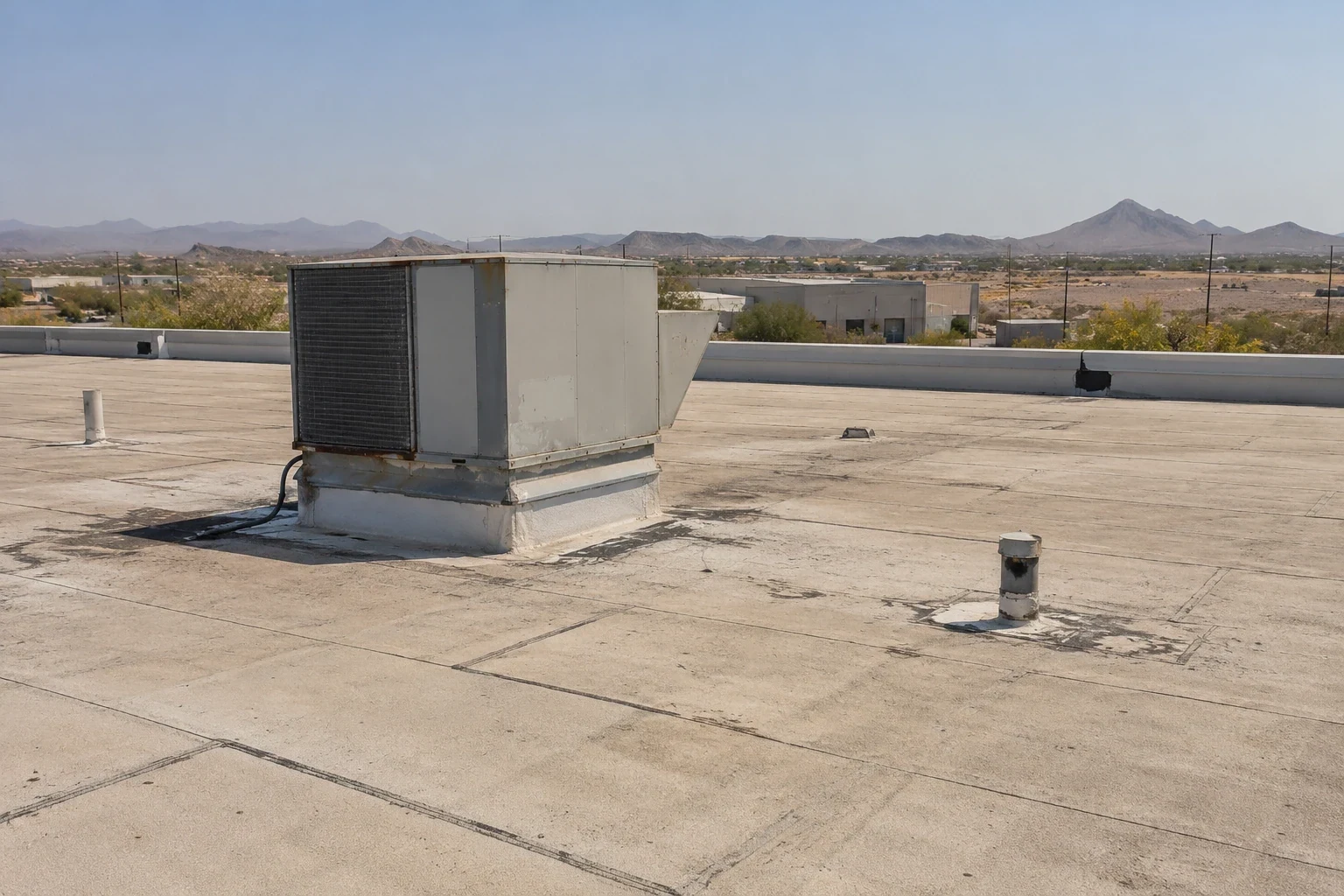
A warehouse roof can pass a walk and still hide wet insulation that quietly distorts a capital decision. The membrane looks flat and clean, the interior shows one stain, and the owner assumes a single patch will close the matter. In Peoria, AZ, the reality is often a larger water path beneath a surface that has taken years of heat cycles. Phoenix-area records show roughly 94 days a year at or above 100 degrees, which works on seams and flashings long before a leak appears. We begin with the evidence that would change the next step: where moisture sits, whether earlier repairs held, and how far the failure reaches. Only then does a scope make sense.
Trace wet insulation before ranking the roof
On a large low-slope roof, the visible defect is rarely the measure of the problem. Water enters at a seam or curb, moves along the top of the insulation and drops into the building a long way from the entry. We map moisture with an infrared moisture survey and confirm the findings with cores, so the repair boundary follows what is wet and not what is stained.
The map gives the owner a defensible number: the share of the roof area that is compromised. A small share points toward targeted repair and a later replacement window. A large share, or wet areas in several separate locations, points toward replacement planning. Either way, the decision rests on a drawing rather than a hunch, and the drawing becomes part of the asset record.
Cores are patched the same day, and each location is photographed and numbered on the roof plan. That way a later survey can return to the same spot and see whether the reading has changed, which is how a slow leak is separated from a stable one.
Read seam and flashing movement against the heat cycle
Heat does not break a warehouse roof in one afternoon. It repeats. Each day the membrane expands, each night it contracts, and the movement concentrates at seams, corners, curbs and edge metal. Over many summers, a sealant that once flexed starts to crack, and a weld that once held begins to peel.
We probe seams, check termination bars and look for shrinkage at inside corners. The pattern matters more than any single finding. If the damage is isolated to one curb cluster, a targeted repair may protect the current budget. If seams are opening across several sections, the same patch repeated on a schedule only moves the replacement horizon without improving it.
Fasteners tell part of the story too. A mechanically attached membrane that flutters between plates wears at each plate, and a few backed-out fasteners can lead to a line of wear that looks like a seam failure from a distance.
Clear the water path ahead of monsoon exposure
Arizona monsoon storms can deliver gusts, hail and flash flooding on the same afternoon. A warehouse roof with a blocked drain or a low spot will show the weakness in a single short burst of rain. Water that stands for hours loads the deck and works on every seam beneath it.
Before the season we walk the route from each low point to its outlet, clear the debris, test drains and scuppers, and check that overflow openings are clear and correctly placed. We also look at wall flashings and parapet caps, since wind-driven rain finds those first. A roof that sheds water cleanly is a roof that ages at a steady rate.
After a heavy storm, a second walk confirms that the drains cleared and that no new debris has collected. The findings from that walk go into the same record as the pre-season check, so the pattern across seasons is visible.
Weigh repair against replacement with a written threshold
Owners need a rule they can apply, not a sales pitch. We set the threshold in writing: what share of wet insulation, how many repeat leaks, what seam condition and what remaining service life would move the roof from repair to replacement. The threshold is tied to the specific building and its use.
A building with temperature-sensitive stock follows the vapor and insulation rules that apply to cold storage. For a roof that clears the threshold, a restoration coating may extend service life when the substrate is dry and well bonded. For a roof that does not, replacement is scoped with insulation and cover board matched to the building. Writing the threshold down keeps the next review from repeating the argument.
The threshold also names the evidence that would change it. A new round of leaks, a failed moisture re-check or a change in building use could each move the roof across the line, and the owner knows in advance which findings matter.
Plan around racking, dock traffic and shifts
A warehouse does not stop for a roof, and a distribution center stops even less. Racking sits close to the deck, product may be sensitive to dust and dripping water, and dock doors operate on shift schedules. We ask which bays are most exposed, where fall protection can be tied off and when the quietest hours occur.
Work is sequenced by roof section, with the open area kept small and sealed at the end of each day. Hoisting happens away from active doors. If the building holds inventory under a leaking section, temporary protection goes in first. The Loop 303 corridor plan set aside 2,625 acres for business park or industrial use in its 2005 planning snapshot. Industrial space of that kind is why the operating plan, and not only the membrane, belongs in the roof scope.
Mechanical and racking contractors often need roof access, so we ask for a schedule of other trades and protect the membrane where they will walk.
Time the capital window against the roof history
The best replacement date is rarely the day the roof fails. It is the date when the budget, the lease calendar and the roof condition line up. We build a roof history from the original specification, repair invoices, warranty papers and survey results, then estimate the remaining service life of each section.
With that record, an owner can compare an early planned replacement with a few more years of repairs, and can see what each choice costs. Facilities in Surprise or Glendale can be included in one roof capital plan so spending is ranked across the portfolio.
Lease dates matter as well. A tenant whose term ends in two years has a different interest in the roof than one who has just renewed, and the plan can show who bears the cost at each stage.
Commercial Roofing Questions
How much wet insulation justifies replacing a warehouse roof instead of repairing it?
There is no single percentage that fits every building, so we set the limit in writing after the moisture map. A small, contained area suits repair. Wet zones that appear in several sections, or that return after repairs, usually justify replacement planning. We show the map and the cost of each path so the owner decides with evidence.
Should a warehouse owner coat the roof or replace it?
Coating suits a roof whose insulation is dry and whose membrane is still bonded. We test adhesion and moisture first. If both pass, a coating can add service life at a lower cost. If either fails, the coating would seal in a problem, and replacement or section repair becomes the better route.
What records should be gathered before a roof assessment?
Collect any warranty papers, original drawings, repair invoices and interior leak reports. Even incomplete files help us date the roof and find earlier repairs. Missing records are noted, and the survey fills the gaps with cores and photographs.
How does summer heat change the order of repairs?
Heat exposes the weakest seams and sealants first, so we rank repairs by active leaks, then by details most likely to fail next season. Work on hot days starts early, since adhesives and sealants behave differently at high surface temperatures.
Can a warehouse keep operating during a full replacement?
Yes in most cases, with phased sections, protected inventory and defined hoisting areas. The plan names the dock doors that stay clear and the hours when noisy work occurs. We confirm these points with the operator before the first day.