Commercial Roofing in Goodyear, AZ
Insulation that has absorbed a little moisture at a time can make a roof look sound for years and then fail a capital plan in one wet season. Goodyear covers more than 191 square miles of land and reported about $4.1 billion in retail sales for 2022, so owners here can hold space that is spread thin across a wide area, with long distances between the roofs that need attention. We work from Peoria, AZ, about 37 miles away in a straight line, which makes planning visits in sequence part of the job. For each Goodyear building the question is the same: how much of the assembly is still dry, what has movement done to the seams, and which scope protects the budget longest.
Test the insulation before choosing a system
The membrane on top is what an owner sees, but the insulation underneath carries the real value and the real risk. Once water reaches it, thermal performance drops, the board loses strength, and a new membrane laid over it inherits the weakness. We locate wet areas with an infrared moisture survey and confirm them with cores, noting the depth of the wet layer and the type of board.
If the wet area is small and contained, the board is cut out and replaced as part of a repair. If it is widespread, a replacement scope includes new insulation and a cover board to protect it from hail and foot traffic. Either way, the survey gives the owner a number for the wet share of the roof, which is the figure that decides between repair and replacement.
Measure how far heat has moved the seams
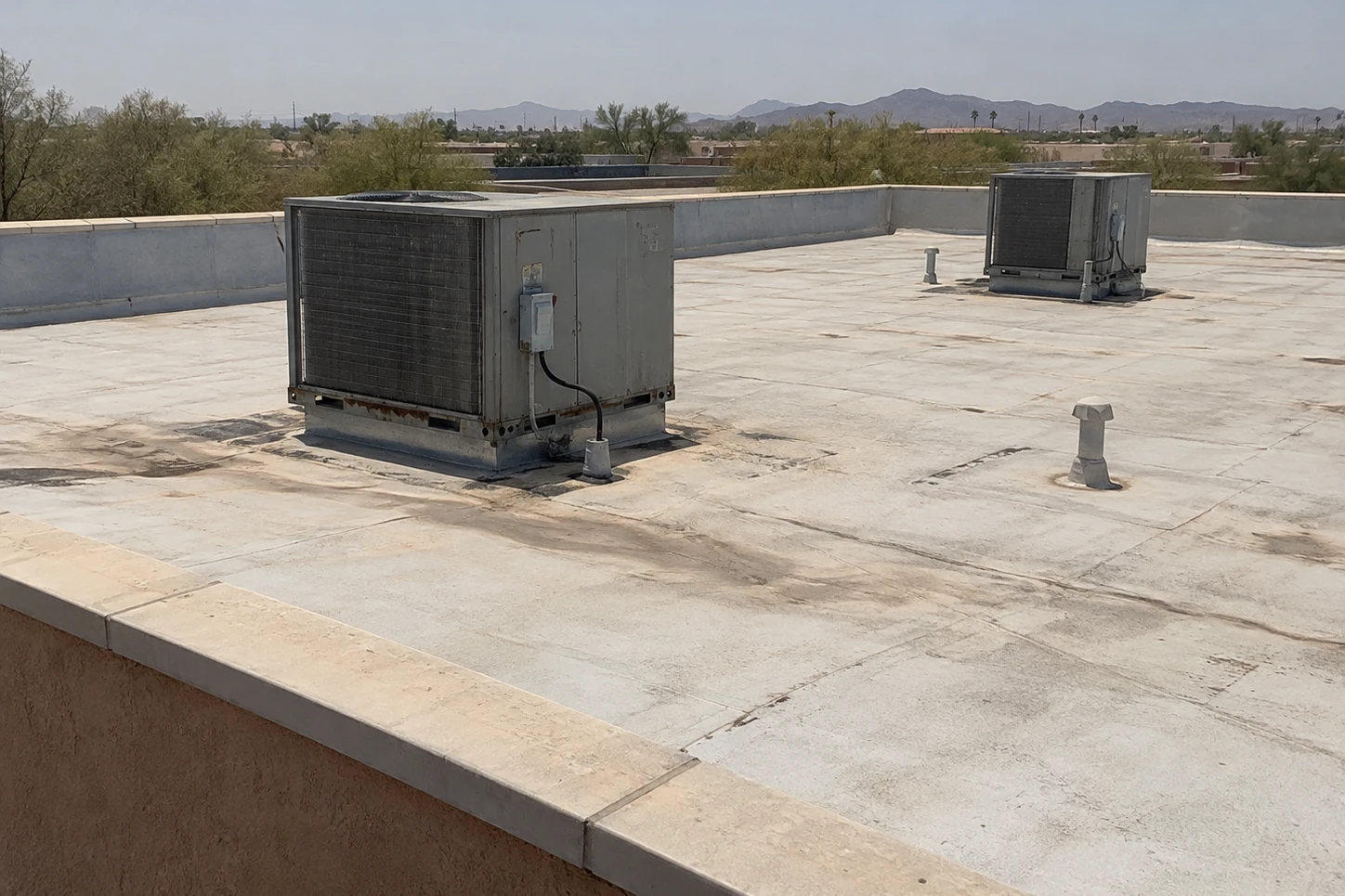
Months of triple-digit afternoons put a daily swing on any membrane laid across a large, open roof. A long run of membrane expands in the afternoon and contracts overnight, and the strain collects at seams, at corners and at every place the roof is pinned down by a curb or a wall. Over years, a seam that was tight begins to open at its edge.
We probe seams along their full length, check how the membrane meets the walls and look for shrinkage pulling away from parapets. A localized problem near a few curbs invites a targeted commercial roof repair. Movement that shows up in many places means the membrane is near the end of its range, and spending on repeated patches simply delays the decision.
Group visits when sites sit far apart
When one owner holds buildings in several parts of a large city, roof work gets expensive if every visit is treated as a separate event. We group inspections by area, carry the same measurement method to each site and produce reports that can be compared side by side. The benefit shows up in the capital plan, because the roofs are ranked by condition instead of by whoever called most recently.
That is the practical point of a roof capital plan: a ranked list, an estimated service life for each section and a spending window that matches the owner's budget. Owners who also manage property in Buckeye or Avondale can include those roofs in the same ranking, so the lowest-condition roof gets attention first wherever it sits.
Read logistics and light-industrial roofs on their own terms
Peoria recorded about $114 million in transportation and warehousing receipts in 2022, a regional sign that distribution and storage play a part in the northwest valley. We do not read it as a statement about Goodyear roofs, and we do not assume a building type here. If an owner does hold a warehouse or flex building, the roof deserves a different eye than a retail strip: wide bays, few penetrations, long seam runs and a dry interior that has to stay dry.
On a roof like that we check the perimeter for wind lift, look at how the membrane is fastened and measure how far water has to travel to a drain. Up in Peoria, the city's 2005 Loop 303 land-use table gave 2,625 acres to business park or industrial use, and owners whose holdings run from Peoria down to Goodyear face the same questions about records and capital timing. A warehouse roof gets a plan built on those answers.
Respond to an active leak without waiting for a scope
A leak at a large building cannot wait for a full proposal. Emergency calls get answered at night and on holidays, and the first visit is about limiting the damage: locating the entry, sealing it temporarily and protecting whatever sits below. Permanent repair comes next, once the roof is dry enough to test.
The leak location, the temporary measure and the permanent fix all go into the asset record. If the same spot fails again, the record shows it, and the conversation shifts from patching to commercial roof replacement. That sequence keeps an urgent call from turning into an unplanned and poorly timed capital expense. The same record shows which other buildings in the group share the detail that failed.
Tenants need to hear plainly what is happening, so we give the building contact a short written summary after each emergency visit: where the water came in, what was done, what remains open and when the permanent work can start. Owners with insurance coverage get photographs taken before and after the temporary work, which keeps the claim record consistent with what the crew actually found on the roof.
Commercial Roofing Questions
How do I decide between repairing a Goodyear roof and replacing it?
Look at three things in the condition report: how much insulation is wet, how many repairs have been made in the same areas, and how many years of service remain in the membrane. Contained wetness and a stable repair history favor repair. Wet zones in separate areas, or leaks that come back after patching, favor a replacement plan. We write the threshold down so the next review uses the same rule.
Is a restoration coating realistic for a roof that has had several repairs?
It can be, provided the repaired areas are sound and the insulation is dry. We test adhesion in several spots, including patched sections, and run the moisture survey before recommending a coating. Previous repairs that were made with incompatible materials sometimes need to be cut out first. If the tests fail, replacement is the better use of money.
What drives the cost of a commercial roof replacement more than the membrane choice?
Tear-off depth, insulation thickness, the number of penetrations, drainage changes and access for hoisting tend to move cost more than the membrane brand. Occupied buildings add sequencing and protection. We price those items separately, so an owner can see what each decision adds instead of receiving one lump figure.
Can wind from a monsoon storm lift a roof that looks fine from the ground?
Edges take the first hit, at the places where the membrane meets the metal and the parapet. Arizona monsoon storms bring microburst winds that can lift an edge. After a storm we walk the perimeter, check fasteners, laps and caps, and photograph anything lifted or torn so the repair and any claim have clear evidence.
How often does a long-span roof need a drain check?
Before the monsoon season and after any heavy storm. Debris collects at low points and around scuppers, and a roof that cannot shed water loads the deck and every seam. We clear outlets, test flow and check overflow openings, then record the condition so a trend is visible from one season to the next.