
Commercial Roof Condition Reports in Peoria, AZ
Photographs of a ponding area tell an owner very little until someone says how deep the water stands, how long it stays, and what lies under it. A condition report is the document that supplies that missing sentence. For roofs in Peoria, AZ, where long heat seasons soften sealants and monsoon rain tests every drain, the report has to do more than list defects. It has to separate isolated damage from systemic wear, show where water has traveled, and give the owner a scope decision that can be defended to a lender, an insurer, or a board. We write the report so a facilities manager can act on page one and an investor can verify the reasoning on page ten.
Walk the roof the way water moves
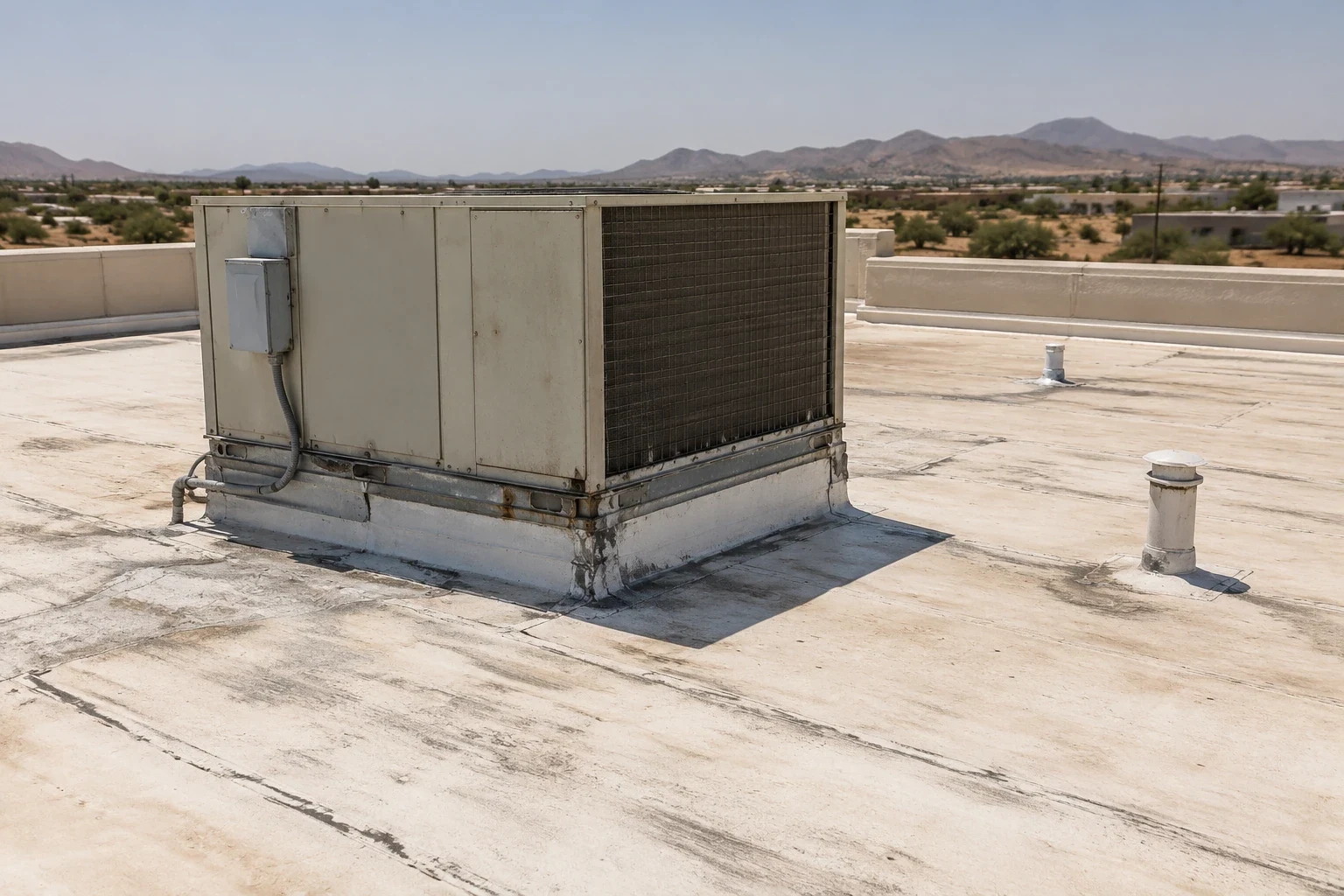
A good report starts with the water path. We walk the roof from the high points to the drains, noting where water leaves the surface, where it slows, and where it stops. Seams, laps, field patches, and terminations are probed on accessible areas. Drains, scuppers, and overflow openings are checked for debris and for how well the surrounding surface sheds water. Rooftop units and conduit supports are examined for damaged flashing and for traffic wear on the membrane around them.
Where access or concealed conditions call for it, a drone roof inspection adds overhead views of large areas and hard-to-reach edges, and an infrared moisture survey maps wet insulation that the surface does not show. Both tools feed the report, but the written findings come from what the crew sees and tests on the roof itself.
Weather on the day matters. A wet roof hides seam defects and makes adhesion checks unreliable, so we schedule dry-surface walks and note recent rain in the report. Heat matters too: crews start early in summer, both for safety and because membranes read differently when they are expanded by afternoon sun. Summer afternoons that pass 100 degrees on about 94 days a year, by Phoenix records, are air readings, but they are why walks are scheduled for morning access.
Read what each section is built to answer
The report is organized by decision rather than by inspection step. An opening summary states the condition of each roof area, the main finding, and the recommended next action. Detail sections follow for membrane and seams, flashing and terminations, drainage, penetrations, and insulation moisture. Each finding carries a photograph, a location on the roof sketch, and a note on severity and likely cause.
Repairs are grouped by boundary. A patch at one pipe boot is described separately from a run of failed laps along a long parapet, because the first is a line item and the second changes the scope. The final section offers options: repair now, repair and monitor, restore, recover, or replace, each with the evidence that would support it. That structure lets a reader skim for the decision and then drill into the proof.
Document each defect so it can be found again
A photograph without a location is a souvenir. We tag each image to the roof sketch, include a wide shot and a close shot of every significant item, and include a scale reference where size matters. When a seam is probed, the report notes the length affected and whether the failure was at the weld edge or within the lap. When a drain is partly blocked, the image shows the debris and the water line around it.
This discipline pays off at the next visit. A future inspector, an insurance adjuster, or a warranty reviewer can open the report and walk straight to the item in question. For owners who maintain a roof asset record, each report becomes a dated entry that shows whether the roof is stable, slowly declining, or failing quickly.
Narrative notes are kept short and specific. A line such as "two open laps, eleven feet, west parapet, dirt-streaked, no sign of prior repair" does more work than a paragraph of general commentary, and it can be checked against the photograph in seconds.
Every photograph carries a caption with the roof area and the finding, so a reader scanning the report can match an image to the sketch without hunting.
Capture the baseline before weather tests the roof
Monsoon storms in the low deserts can carry damaging wind and microbursts, according to the National Weather Service. The October 2010 supercells that crossed the metro area dropped large hail and left extensive damage. A condition report completed before a storm season establishes what the roof looked like beforehand: which flashings were already lifting, which seams were already open, which drains were already slow.
After a severe event, that baseline helps separate new damage from existing wear, which matters when an owner is preparing a claim through roof insurance claim assistance. An adjuster can compare photographs instead of relying on memory, and the owner can discuss scope with specifics rather than general impressions.
Use the report where money changes hands
Refinancing, acquisitions, lease negotiations, and insurance renewals all lean on roof condition. A report written to a consistent scale gives each party the same facts. For downtown and Old Town Peoria, where downtown zoning mixes civic, historic, residential, commercial, and employment uses in small subdistricts, roofs on older buildings often carry mixed repair history, and a written baseline helps a buyer price the unknowns. For newer industrial and commercial space along Loop 303, a report records the roof at the start of a lease or ownership, which becomes the reference point for later disputes.
When a transaction is involved, we coordinate with the survey team described in due diligence roof surveys so deadlines are met and findings carry into the closing file.
Commercial Roofing Questions
How long does it take to receive a written report after the roof visit?
Turnaround depends on roof size and whether moisture mapping or overhead imagery is included, because the report cannot be finalized until those results are processed. We confirm the delivery date when scheduling, and urgent leak situations get a short written finding first so repairs are not held up by report formatting.
Will the report tell me what a replacement costs?
The report states what is wrong, where, and which scopes the evidence supports. Pricing is developed from that scope, because cost drivers such as tear-off depth, insulation condition, drainage changes, and access are determined by the findings. If you need budget ranges for planning, we pair the report with a capital planning forecast.
Can one report cover several buildings on a business park site?
Yes, as long as each roof area is identified and rated separately. A park with several buildings, such as the clusters listed in the Arrowhead business park records, usually contains different roof ages and systems, so the summary table shows each building on its own line. Combining them without that separation hides the roofs that drive the decision.
What if the report finds nothing urgent?
A clean report is still useful. It records the roof at a known good point, lists the items to watch, and gives a planning window. Owners often use it to justify deferring a project, to support a lender request, or as the starting entry in a maintenance log.
Does the report include moisture results from the infrared survey?
When the survey is part of the visit, the report includes the thermal images, a map of suspect areas, and notes on what was confirmed by core samples or moisture meter readings. Thermal imaging points to areas worth testing, so the report ties each flagged area to a physical check before drawing conclusions about the assembly.