
Military Barracks Roofing near Peoria, AZ
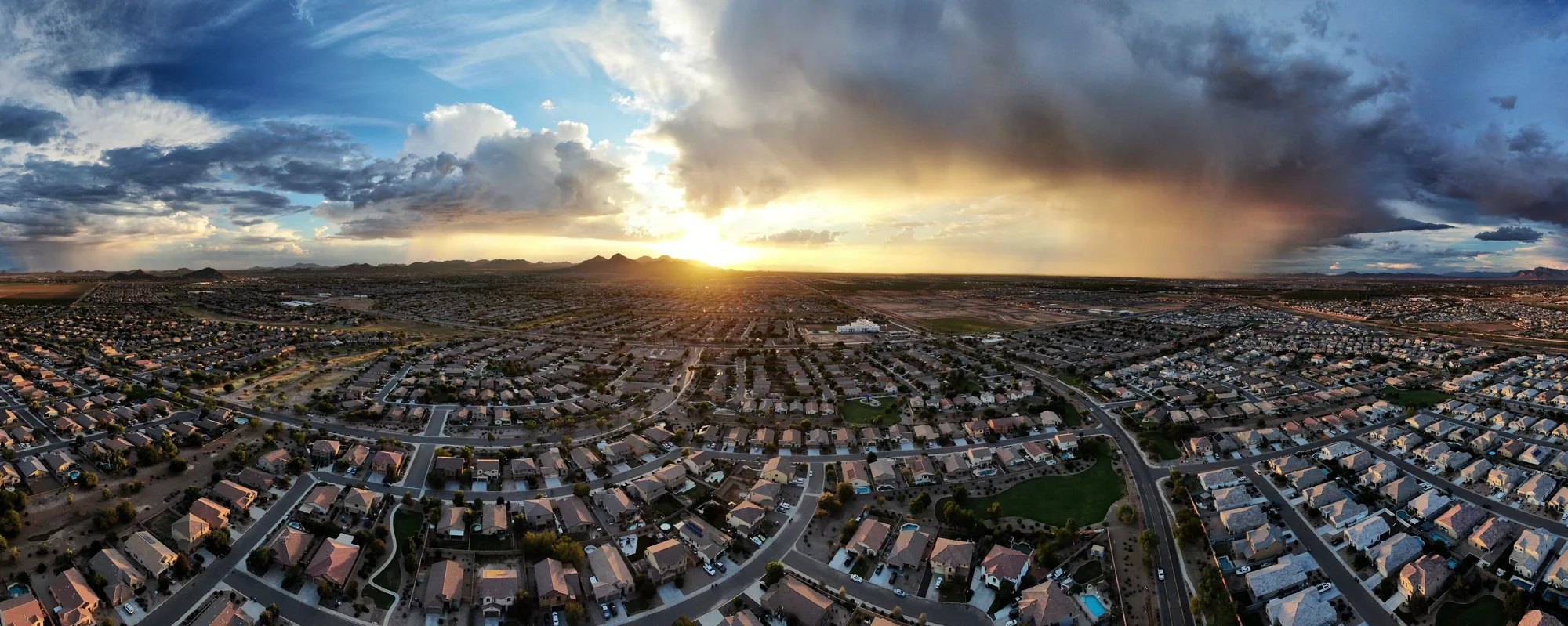
Across a dormitory wing, the same roof detail repeats above every room module, so one defect type can recur down the whole length of a wing. A leak patched over one room can return over its neighbors for the same reason. Luke Air Force Base, a straight-line 17 miles southwest of Peoria, keeps housing records that list 11 permanent-party enlisted dormitories and a pipeline dormitory of 905 rooms; that points to a barracks-type roof inventory, not to the condition of any roof. What we need first is the moisture map, the repair record and a read on how far the pattern repeats.
Trace the repeated detail before patching the single room
When a dormitory wing leaks in several rooms, the cause is often a shared detail: a parapet flashing, a drain, a curb line or a row of penetrations that repeats along the roof. Patching the stained room treats a symptom. We map every stain along the wing, walk the roof above them and look for the detail that the stains have in common.
Once the pattern is clear, the repair can address it for the whole wing. A flashing replaced along one wall, a drain reset and re-flashed or a row of boots renewed together costs less over time than a string of single-room patches. An infrared moisture survey shows wet insulation along the line, and a probe confirms it.
Stair towers, entry canopies and attached laundry or day rooms add roof transitions of their own. Where a building has them, we inspect the junctions where a low roof meets a taller wall, because differing movement concentrates stress at those joints.
Protect residents and sleep schedules during the work
Barracks are homes. Residents work shifts, train and sleep at different hours, and roof noise travels through a thin ceiling. We coordinate with the housing office on work hours, wing-by-wing sequencing and quiet periods, and we post a short notice for each wing before the crew arrives.
Our occupied building reroofing plan covers the practical points: protected entrances, air intakes shielded from fumes and dust, debris controlled in covered containers and each opened roof section dried in before the crew leaves. A leak that shows up indoors mid-job halts the crew until the room is covered and the opening closed.
For owners with housing across the Peoria market and beyond, the same notice format and quiet-hour plan carry over from one building to the next.
Residents receive plain-language notices that say which wing is affected, what time work starts and whom to call about a problem.
Plan base access, escorts, and material control
Work on a base starts with the paperwork. Expect badge checks or escorts for people, approvals for vehicles and inspection of deliveries at the gate. The housing or contracting office is asked for its rules before mobilization, and they go straight into the work sequence.
Barracks roofs typically fall under Unified Facilities Criteria, so the proposal cites the criteria in force and maps the new assembly to them. That means reading the criteria beside the existing roof and writing the scope from the gaps. Each day's log lists who was on the roof, which areas were opened and how they were closed. The same method applies on an Air Force base and on an Army installation.
Inspect mechanical penetrations and cooling equipment
Dormitories need cooling, ventilation and plumbing, and each system puts penetrations through the roof. Boots and curbs flex with every heat cycle, and the Phoenix area sees roughly 94 days a year at 100°F or hotter. Air temperature is not roof temperature, but the repeated swing is what cracks sealant and hardens boots.
We inspect each rooftop equipment curb and support as part of a cluster, noting flashing condition, fastener integrity and drainage around the base. Condensate lines that rest on the membrane wear through it, so we recommend supports and walk pads where service crews travel. Monsoon winds and microbursts, named in NWS guidance, make edge metal part of the same check.
Drains and scuppers are cleaned, flushed and tested before storm season. A blocked drain over a long wing holds water against flashings, and ponding that stays a day after rain is measured and mapped.
Rooftop solar or antenna mounts, where a building has them, are inspected for flashing condition and attachment, since they add fasteners through the membrane that must stay sealed.
Set the replacement horizon across a dormitory group
A group of dormitories invites a program view. Each building gets sections, ratings, repair history and a review date, and the housing office ranks them by risk and cost. Isolated defects on dry insulation get repairs. Moisture in several areas, or defects repeating wing after wing, mean replacement planning.
That multi-site roof program format helps an owner defer or act with a reason, and it works across a base, a Guard site and civilian housing such as an apartment roof. Price follows tear-off depth, insulation, penetrations, escort time and the hours the base permits. The closeout file records sections, products, moisture readings and photographs.
Written thresholds make the budget conversation shorter. A wing that tests dry and sound this year can be deferred with a note on what to recheck, while a wing that does not is scheduled with a date.
Compare barracks with civilian housing and growth areas
Peoria's population rose from a 2020 count of 190,985 to an estimated 200,881 in 2025, and the city plans employment growth along Loop 303 that includes aerospace and defense uses. Planning is not completed building stock, and none of it describes a barracks roof. It does explain why housing owners in the northwest Valley favor one shared roof-record format.
A civilian apartment complex, a dormitory wing and a reserve center all share the same questions: where moisture sits, which repairs held and when the next decision falls. The answers differ, and the access rules differ more, so we write each building's plan from its own inspection.
Commercial Roofing Questions
Why do leaks recur along a dormitory wing after a patch?
The detail causing the leak repeats along the wing. A flashing, a row of boots or a drain line may be failing in the same way above each room. Patching one stain leaves the others. We map the pattern and repair the shared detail together.
How do you schedule roof work above residents who sleep at different hours?
Coordinate with the housing office on a wing-by-wing sequence and set quiet periods. Notices go to each wing before work. Noisy steps are planned for approved hours, and any leak inside stops the job until the room is protected and the opening is repaired.
What does a base housing office need to see in a roof scope?
It needs the access plan, the sequence by wing, the criteria the assembly will meet, the protection for residents and the closeout record. We write each as a section of the scope so the office can review it against its own rules.
Does a heat wave mean dormitory roofs will fail?
No. Heat is a reason to inspect seams, sealants and boots before summer, not proof of failure. Phoenix-area records describe a long hot season, and we use that to time inspections and to plan material handling and crew hours.
What records should be kept for a group of barracks?
Keep one file per building with sections, ratings, repair history, photographs, moisture readings and review dates. A common format lets the housing office compare buildings and spread capital across funding cycles.