
Big-Box Retail Roofing in Peoria, AZ
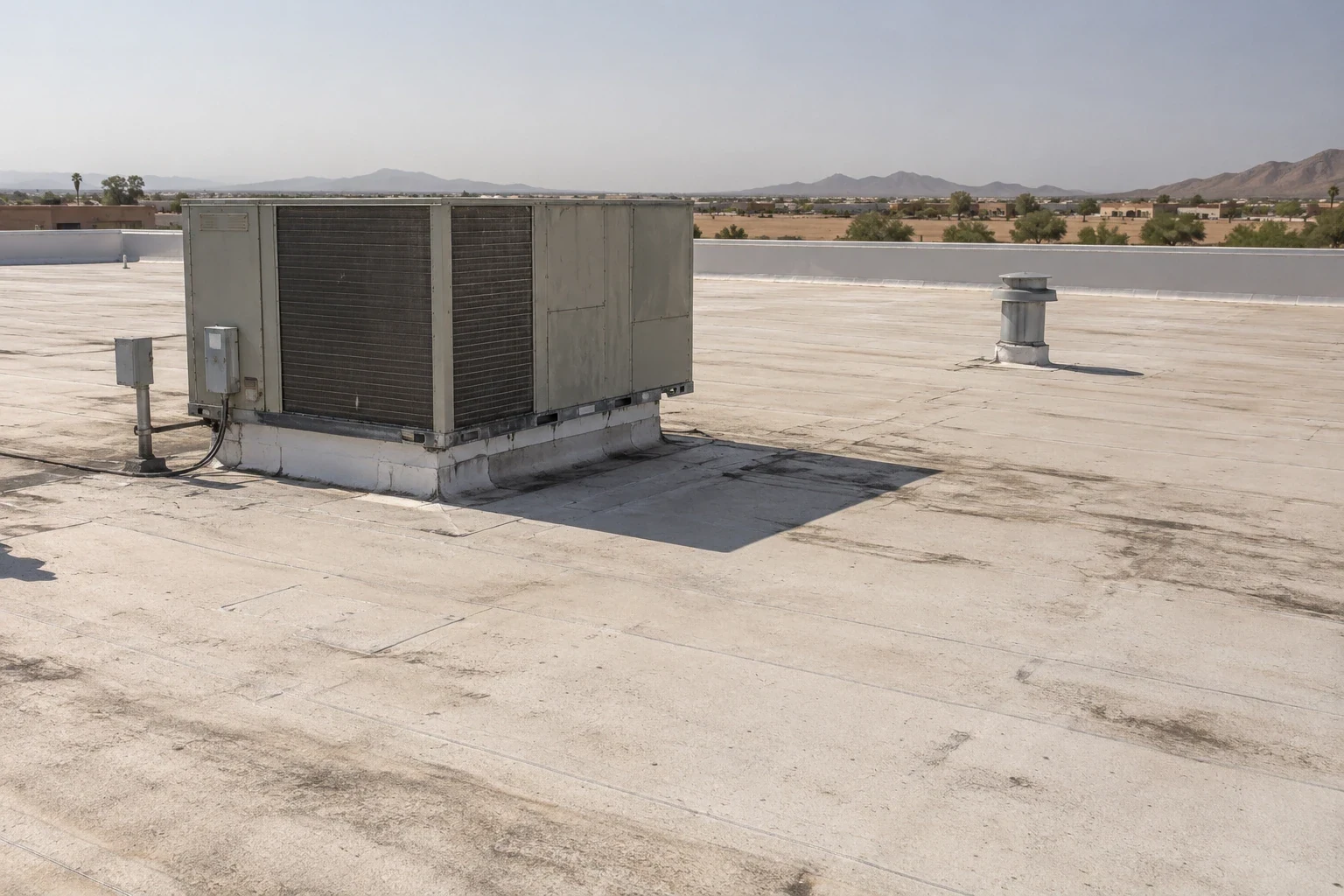
A big-box roof is one wide field with a handful of expensive weak points, and the weak points set the plan. The field may be sound for years while a drain sump, a curb group or a parapet corner leaks every storm. In Peoria, AZ, Census figures record about 4.9 billion dollars in 2022 retail sales, and heat cycles, monsoon wind and short bursts of heavy rain work on every large retail roof in the city. For an owner or a retail real estate team, the useful question is how much of the roof is actually in trouble, which details are driving the leaks and whether the evidence supports repair now or a planned replacement later. We start by separating the field from the weak points.
Survey the field first, then the weak points
On a large single-story roof, we divide the surface into a grid and walk it section by section. We look for ponding, seam wear, surface damage and signs of past repairs. Then we turn to the details: drains, scuppers, curbs, parapets, expansion joints and rooftop equipment.
An infrared moisture survey adds the hidden layer, showing wet insulation that a walk cannot detect. The combined result is a map with three zones: sound, repairable and compromised. The share of area in each zone is the first number an owner needs, because it frames every cost conversation that follows. A roof that is mostly sound with scattered weak points reads differently from one with wet zones across the field.
Cores and probes confirm the readings. We cut a few small samples in the flagged areas, check the insulation and deck and patch each hole the same day. The cores also show how many layers the roof has and whether earlier recovers were added.
Size the drainage route to the span
Large roofs concentrate water. A long run to a few interior drains can overwhelm an outlet in a short, heavy storm, and a blocked sump can load a wide area with standing water. Ponding then works on seams and the deck for hours after the rain ends.
We trace each drainage area, clear sumps, test flow and confirm overflow scuppers are set at the right height. Where ponding persists, we look at deflection, insulation compression and drain placement. A ponding water repair may involve tapered insulation, an added drain or a reset sump, and the choice depends on the cause. The goal is a roof that sheds water within a day of rain.
Expansion joints and area dividers, common on very long roofs, are another weak point. Their membrane covers stretch with the structure through the heat cycle, and a worn cover can pass water into the building without any visible hole.
Document hail and wind with the roof's own baseline
Large hail from supercells caused extensive damage across metro Phoenix in October 2010, and monsoon storms bring gusts and flash flooding on top of the hail risk. A large flat roof is a wide target, and an owner without a baseline cannot easily separate new damage from old.
We photograph the roof in good weather and again after a significant storm, then compare. Bruised membrane, cracked coatings, dented metal accessories and displaced coping are logged by section. That record supports a decision on hail damage repair and, where warranted, an insurance claim. If the roof shows nothing, the record says so, which has value too.
Fasteners and edge metal deserve special attention after wind. A mechanically attached sheet that flutters will wear at each plate, and a loose coping run can admit rain far from where the wind pulled it. We check both and record what we find.
Coordinate rooftop units, refrigeration and exhaust
Big-box stores carry many rooftop units, and some carry refrigeration condensers or kitchen exhaust. Each brings curbs, lines and traffic. Technicians walk the same paths every month, and a worn path in the membrane is often the first leak on an otherwise healthy roof.
We map service routes, add walk pads where traffic is heavy and check equipment curbs and supports for flashing condition. Any work on refrigeration lines is coordinated with the store's mechanical contractor, since a mistake can threaten product. When equipment is replaced, new curbs and flashing are built before the unit is set.
Condenser and exhaust areas collect heat, oil and moisture, and the membrane beneath them often ages faster than the field. A protective layer or a replaceable wear pad lengthens the interval before that section needs attention.
Stage work around store hours, receiving and seasonal peaks
A store cannot close its roof for repairs, so the work is staged. Receiving docks need clear access at set hours, entrances need safe paths and the holiday season limits what can be done. We ask for a blackout calendar and plan the schedule around it.
Roof sections are opened one at a time and closed daily. Material staging is placed away from fire lanes and customer parking, and lifts are scheduled outside peak traffic. For retail chains, a standard staging plan can be reused across stores, with adjustments for each site's access. Grocery stores add food-safety and refrigeration limits that tighten the plan further.
Weekend and overnight work is sometimes possible for the loudest tasks, and we price it separately so the owner can compare the cost of night work against the cost of disruption during the day.
Choose between recover, coating and replacement on evidence
With the map in hand, the options become concrete. A recover may suit a roof with dry insulation and a sound deck. A coating may extend life when the membrane is bonded and dry. Replacement is warranted when wet insulation is widespread or repeated repairs have stopped holding.
We lay out the cost, service life and risks of each path and name the evidence that would change the choice. Owners with sites along the Loop 303 employment corridor or the Camino a Lago commercial core can compare roofs across a portfolio. A smaller shopping center in the same portfolio follows the same record with adjustments for its multiple tenants.
Warranty status deserves a check before any option is final. Some coverage requires specific repair methods, and a mismatched patch can limit it. The warranty file is reviewed at the start and kept current in the roof record.
Commercial Roofing Questions
What share of a big-box roof can be wet before replacement makes sense?
There is no universal figure. We set a limit after the moisture map, using the roof's age, leak history and remaining service life. A small contained area suits repair, while wet zones in several sections or repeated failures usually point to replacement planning.
How often should a large retail roof be walked?
At least twice a year, before the monsoon season and in the fall, plus after any severe storm. Each walk follows the same checklist and adds photographs to the record. A consistent format makes small changes visible.
Can a store stay open during roof replacement?
Yes in most cases, with sections opened one at a time, protected interiors and defined hoisting areas. Receiving and customer entrances are kept clear. The plan names the hours for noisy work and the person who can stop work if conditions change.
What is the best way to handle rooftop unit replacement?
Coordinate the mechanical and roofing trades so the curb and flashing are built before the unit is set. This avoids a temporary seal that fails and ensures that warranty requirements are met. The plan also protects the membrane along the crane path.
Do retail chains need a separate plan for each store?
A common framework works, with adjustments for each store's roof, access and operations. The framework covers records, inspection steps, repair rules and thresholds. Each store's file then shows how it compares with the others.