Commercial Roofing for Hospitality Groups in Peoria, AZ
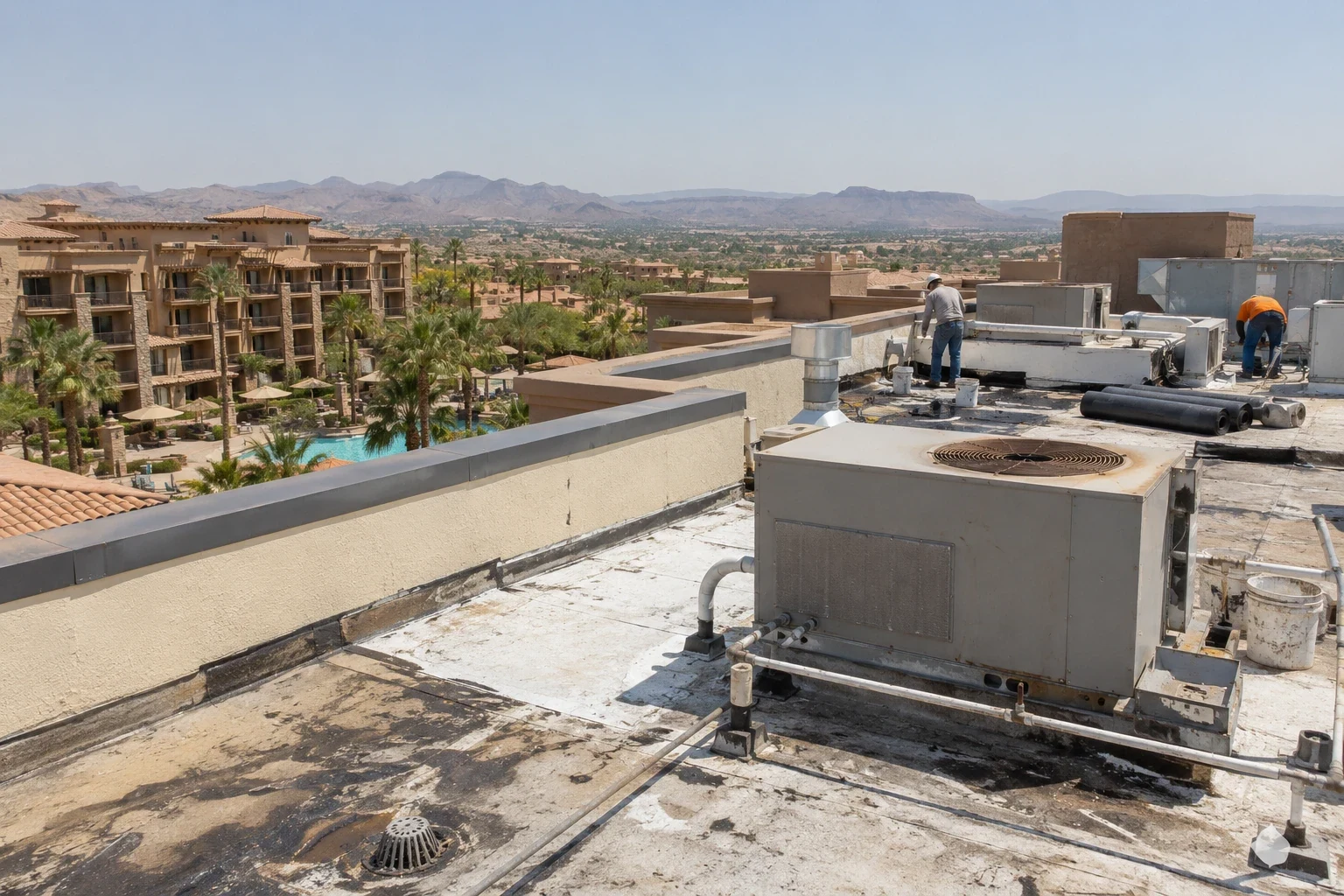
A room complaint and a roof defect can be separated by several layers of deck and insulation. The guest-facing response may need to happen immediately, while the permanent scope depends on tracing the water path above. In Peoria, AZ, heat works on exposed seams and sealants, and monsoon storms can test edges and drains with wind, hail, and rain. We inspect the building, document the repair boundary, and schedule work around guest movement, food service, and the operating calendar.
Keep guest routes clear during roof work
Hotels and hospitality buildings have entrances, loading areas, pool or event schedules, kitchen exhaust, and guest rooms that cannot be treated as a single work zone. We coordinate access with the property contact, confirm staging and lift locations, and identify rooms or public areas below the active roof section. If work creates noise or requires an equipment shutdown, the sequence should state when it happens and who needs notice.
A larger project can be split into areas that can be secured and dried in at the end of the shift. A reroof on an occupied property may proceed in phases when the assembly and weather window support it. We coordinate temporary closures and equipment needs with the hotel team before opening the roof. The goal is a work sequence the property can schedule, not a promise that construction will be invisible.
Find the roof entry before closing the guest report
Water over a guest room or function area can begin at a curb, seam, drain, or roof edge and travel before appearing inside. We inspect the area above the report and check nearby flashing, membrane transitions, equipment supports, and prior repairs. If visible conditions do not establish the moisture boundary, an infrared moisture survey can help direct confirmation tests. The repair recommendation follows the roof condition, not only the point where the ceiling changed.
When a single detail has failed and the surrounding assembly remains sound, a focused repair can address the opening. Repeat leaks or wet insulation across separate areas may require a broader scope. For a hotel leak, establish the affected room or service area, whether water is still moving, and how guest circulation can be protected during inspection. We report what was done to protect the building and what permanent work remains, giving the property manager a clear update for guests and ownership.
Coordinate exhaust and rooftop equipment
Kitchen exhaust, HVAC units, signs, laundry equipment, and later-installed lines create roof penetrations that need durable flashing. We check the curb or support, adjacent membrane, fasteners, and water path. Where a kitchen or plant room must remain operational, the hotel contact helps schedule any shutdown and identifies the staff member who can approve access. The roof crew then works within that boundary and records any change in scope.
A roof system may be sound while a penetration detail needs attention. We distinguish that repair from a field-wide condition by looking at nearby seams and moisture evidence. A condition report ties the finding to photographs and an area sketch. If the same detail recurs across several properties, the portfolio can compare the repair history without assuming that each building has the same roof design.
Use storm and heat records as inspection context
Long hot periods make exposed seams, sealants, perimeter metal, and flashing useful inspection points on hotel roofs. We log movement or separation by zone, then connect a repair recommendation to the condition seen on that property and identify any follow-up check.
Before the summer storm season, inspect drains, overflows, edges, and equipment curbs near guest or service routes. After a storm, a storm damage review compares those roof zones with the prior visit and identifies any temporary protection needed. A maintenance plan can also keep the roof file current as staffing, equipment, or guest-use patterns change.
Read Peoria’s hospitality districts as different settings
Peoria planning describes P83 as a roughly 600-acre mixed district near Loop 101 and Bell Road, with commercial, hospitality, entertainment, employment, and residential uses. The open-air Park West retail and dining center sits beside Loop 101 at Northern Avenue. Nearby hospitality properties can have distinct arrival, loading, and guest patterns, so we set the work sequence with the property team and inspect the roof itself.
For a property near P83 or the Park West district, we coordinate the work plan with the property’s own guest, tenant, and delivery patterns. For a north Peoria property, the city’s employment and commercial planning along Loop 303 toward State Route 74 can inform future access discussions. Existing roof decisions still come from the hotel’s own inspection and records.
Carry the condition into the ownership plan
Hospitality properties often need work scheduled around event calendars and occupancy forecasts. A roof report gives ownership the condition, repair boundary, cost drivers, and schedule constraints needed to decide when the project fits. If dry insulation and isolated defects leave restoration viable, a coating may be evaluated after substrate and adhesion checks. If water or repeated failures extend across separate roof areas, the recommendation may move toward replacement. For phased reroof work, confirm guest circulation, loading access, and mechanical service routes before setting each crew area; rooms and service spaces may need different work windows.
For a group of properties, we keep each building’s evidence separate while making the priorities comparable. The retail and restaurant roof schedule can share a common format; the property management record can carry repair and warranty information to the next operator. A capital window states the trigger that would move the project earlier, such as another leak or confirmed moisture outside the original boundary. We can also align the review with a lender inspection, planned room renovation, or equipment upgrade when those dates affect roof access.
Commercial Roofing Questions
Can roof repairs be completed while guests remain in the building?
Often, if the work can be sequenced around guest routes, room use, equipment, and weather. We coordinate the affected area and timing with the property contact, including any noise or temporary access changes. The crew secures the roof at the end of the shift and informs the contact if a concealed condition changes the next day’s plan.
How should a hotel respond to a ceiling leak during a busy period?
Protect guests and contents below, notify the property contact, and arrange safe roof access. We inspect the likely entry area and nearby details, then document temporary control separately from permanent repair. The room location helps direct the inspection, but water can travel before reaching the ceiling.
What roof details deserve attention around a commercial kitchen?
Exhaust curbs, grease-related service access, nearby membrane transitions, and drainage should be checked as one area. We inspect the flashing and adjacent field, then coordinate equipment shutdown or kitchen scheduling with the operator. The scope identifies the detail that failed and what must be done to keep the opening weather tight.
How can ownership rank roof work across several hotels?
Use a shared rating method but maintain a report for each property. Active leaks, repeat repairs, confirmed moisture, guest impact, and access constraints affect priority. The portfolio summary can show order and timing, while photographs and roof sketches explain the recommendation for each location.
When is coating a reasonable option for a hospitality roof?
Only when the existing assembly is suitable and the substrate, adhesion, and moisture conditions support it. We inspect the membrane and repair defects before recommending a coating. If insulation is wet or failures extend across separate areas, a surface application will not correct that condition.