
Wind Damage Roof Repair in Peoria, AZ
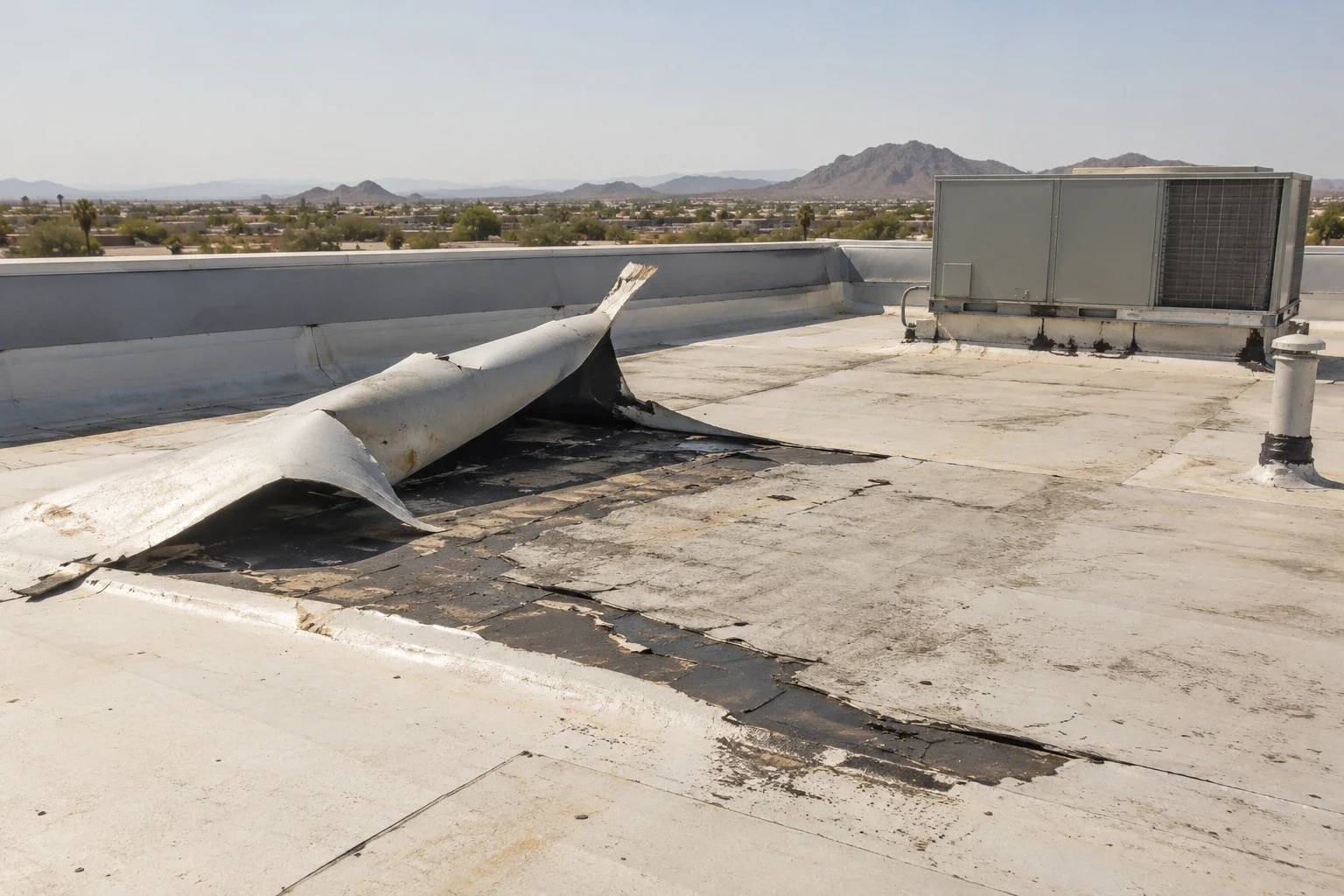
A lifted corner can leave the rest of a roof looking unchanged while wind has loosened the edge that holds it in place. In Peoria, AZ, a gust front can move from the open roof perimeter to curb flashings, seams, and equipment screens in a short stretch of roof. Monsoon outflows in this region can send sudden gusts across low-desert roofs. That background makes perimeter attachment worth checking, but it cannot establish the cause of damage on an individual property. The first repair question stays specific: what shifted, what remains bonded, and did water reach insulation or deck?
Read the perimeter before the field
Wind pressure does not act evenly across a membrane. Corners and roof edges see a different pull than the center of the deck, while parapet caps, coping joints, and metal edge cleats can open as the assembly flexes. We check fasteners, laps, termination bars, sealant, and the substrate beneath the edge metal. A loose cover may be a sign of failed attachment below it, so tightening a visible piece without checking the connection can hide the next failure.
We mark each lifted, bent, or missing component against a roof plan. Peoria planning treats Loop 303 as a north-side employment spine. That setting can help orient access, but the repair still follows the membrane, deck, and edge assembly we inspect at the property.
When the damage is concentrated at a transition, our edge metal and coping work can restore the termination without disturbing sound field membrane. If uplift or displacement continues across a larger zone, we map that boundary before selecting a broader commercial roof repair.
Trace the water path after the gust
A wind opening can admit rain far from the ceiling stain. Water may travel along a deck flute, insulation joint, or mechanical support before it reaches an occupied room. We compare interior reports with the roof surface instead of assuming that the wet ceiling below marks the breach. Where the pattern stays unclear, an infrared moisture survey can help identify areas that need closer confirmation, followed by targeted probes when the roof assembly calls for them.
Drainage deserves a separate pass. Wind can move debris against an outlet, dislodge a strainer, or expose a low spot that already held water. We check drains and overflow routes, then distinguish new storm debris from a condition that existed before the event. A ponding area is not automatically storm damage, and a dry roof does not erase a displaced flashing detail. Each observation gets its own location and repair recommendation.
Protect exposed areas without losing the record
When a section is open to weather, temporary protection controls water but does not complete the repair. We secure covers against gusts, direct runoff away from entrances, and record the location and installation date. A revisit point keeps an interim measure from hiding the original edge condition.
For a claim file, keep initial photographs, weather notice, leak locations, and invoices together. Our claim documentation support can organize confirmed damage separately from items needing more investigation. That produces a clear scope without promising an insurer's decision.
Separate repairable damage from a wider failure
A repair is a reasonable choice when attachment remains sound around a limited opening and the surrounding membrane is dry and stable. We remove failed material to a firm boundary, restore the compatible layers, and detail seams or flashings so water cannot migrate under the patch. If multiple edge zones have released, fasteners have pulled through, or moisture appears in separate areas, repeating isolated patches may leave the cause in place. The inspection record should show why the repair stops where it does.
System type changes the method. A single-ply sheet, modified bitumen, built-up roof, and metal retrofit each use different seams and transitions. We identify the assembly before applying a repair material, check compatibility, and avoid coating over loose, wet, or contaminated surfaces. If hail has also marked the membrane, the separate hail damage review can distinguish punctures or fractured details from wind displacement.
Cost and timing depend on access, tear-out depth, wet insulation, deck condition, equipment coordination, and how much edge must be rebuilt. A roof with one open corner can move quickly once the attachment is understood. A roof with recurring perimeter movement may require testing and a larger replacement boundary. We put the observed condition and the work assumption beside each other so the owner can see what is included.
Use the event to set a useful review window
The right response is not always a full replacement after a storm. First establish whether the system has a local defect, a failed attachment pattern, or damage that has reached the insulation and deck. Next compare that finding with prior leak calls and repairs. If the same edge has been reopened repeatedly, the repair history may point to a larger assembly issue even when the latest gust only exposed one spot.
Peoria's north planning area includes the Peoria Innovation Core along Loop 303 and Lake Pleasant Parkway, a planned mix of employment, commercial, residential, and open-space uses. That is a land-use plan, not proof of completed buildings or a roof inventory. For owners with changing assets, the useful connection is operational: keep roof condition, repair dates, and capital timing attached to each property rather than relying on a corridor-level assumption.
A dated condition record can support a defer-or-act decision. It should list confirmed damage, areas that were inaccessible, temporary measures, and the next inspection trigger. If a second storm occurs before permanent work, the record can show which conditions are new. We can also compare wind findings with ponding-water conditions where drainage or deck deflection complicates the leak path.
Leave the owner with a repair boundary
The closeout should make the next decision easier. We provide photographs, a marked location map, notes on the exposed layers, and a clear list of repairs completed or deferred. Where the roof could not be accessed, that limit belongs beside the finding rather than buried in a general note. The owner can then compare the present condition with the next storm inspection and know what changed.
Peoria's mixed downtown zoning includes civic, residential, commercial, employment, and historic uses, so roof work may sit above different operating needs within a compact area. The roof review still stays specific to the building: occupied spaces, equipment, access, drainage, and the condition of each assembly. For properties around Peoria, the Peoria service area is supported by the same field review and written repair boundary, without assuming that neighboring roofs share a construction history.
Call with the leak map, repair record, or current photos if you have them. We will compare that history with a focused roof review and ask what decision the next inspection must support. The result should distinguish immediate water control from permanent work and identify when the perimeter needs another look.
Commercial Roofing Questions
What should be checked first after wind lifts an edge or coping section?
Start with attachment, not appearance. We inspect the metal, cleats, fasteners, membrane termination, and the substrate that carries the edge assembly, then photograph the condition before anything is moved. If the area is exposed, we set safe temporary protection and mark the return point for permanent work.
Can a ceiling leak show up away from the wind opening?
Yes. Water can travel across a deck flute or insulation joint before it reaches an interior finish. We compare the stain location with roof details, drains, curbs, and penetrations, then use moisture checks where the path is uncertain. The repair boundary follows confirmed evidence, not the ceiling mark alone.
When is a local wind repair enough?
A local repair may hold when the opening is limited, attachment around it remains sound, and adjacent insulation is dry. Repeated movement across several edge runs or separated wet areas calls for a wider review. We record what supports the boundary so the owner can revisit it after another event.
Does wind damage automatically mean a replacement is due?
No. Replacement depends on the distribution of damage, moisture below the membrane, attachment condition, and repair history. We distinguish a repairable edge or seam from a pattern that crosses multiple sections, then show the cost and timing assumptions behind each option.