
Government Building Roofing in Peoria, AZ
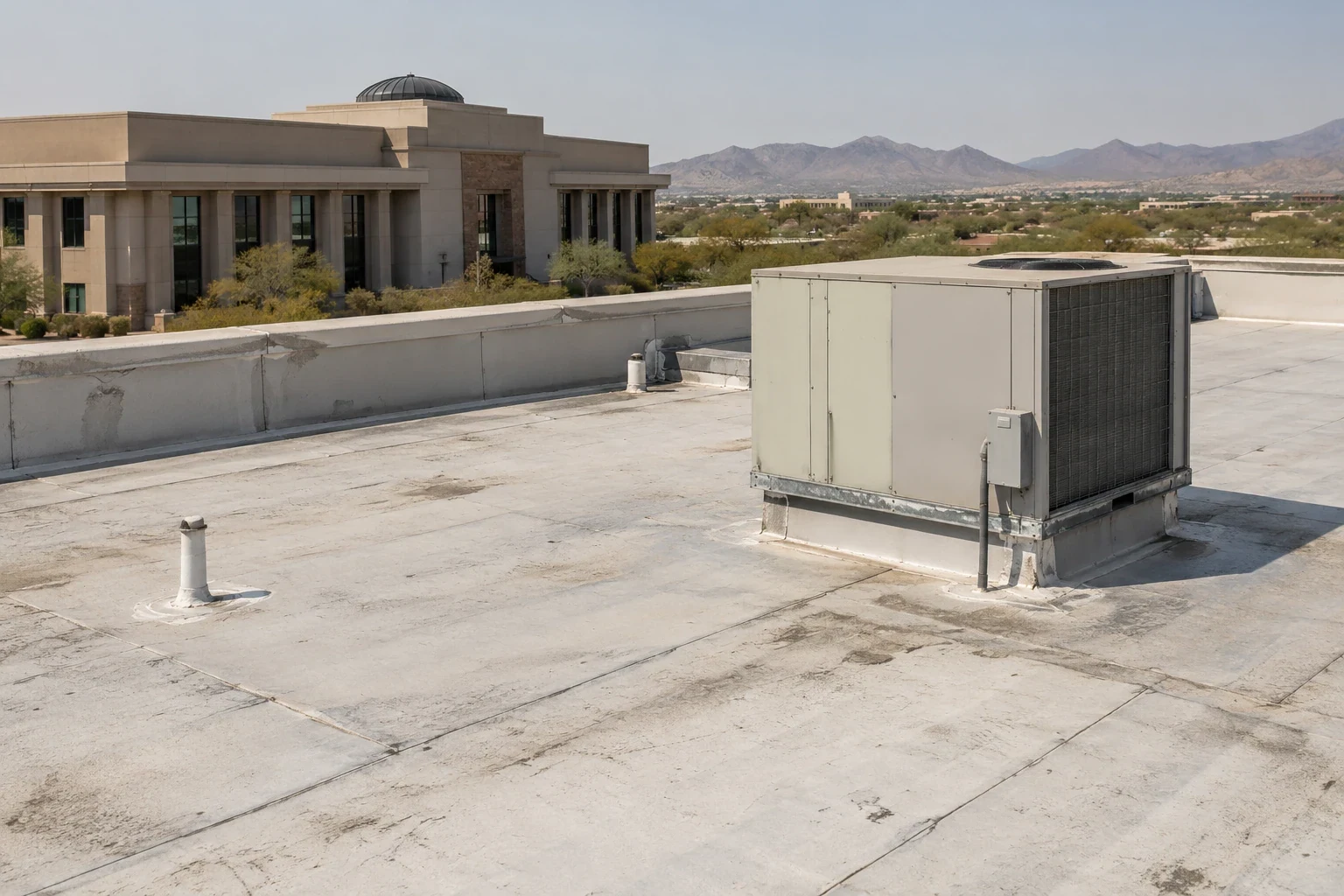
A government building can show a clean membrane at the roof surface while a layer of wet insulation sits below it, waiting to surface in the next budget hearing. Public roofs are often managed on a calendar that was set before the roof reported its condition, and a replacement scheduled by age may land on a roof that could have waited, or miss one that cannot. Each Peoria summer and monsoon season works on seams, curbs and edge metal, so condition drifts. We start with the record: moisture locations, repair outcomes and the extent of any failure. Then we write a scope the board, the facilities office or the council can review.
Document the roof before the budget cycle starts
A public owner needs a roof record that can be read by someone who has never been on the roof. We walk each section, photograph seams, flashings, drains and penetrations and map moisture where the interior evidence is unclear. The result is a roof condition report with ratings by section, not a single grade for the whole building.
That structure helps in a budget meeting. A section with dry insulation and an isolated defect gets a repair line. A section with wet insulation in several areas gets a replacement line with a date. The report shows what is known, what is unknown and what the next inspection would need to prove, so staff can answer questions without guessing.
Interior evidence completes the record. Ceiling tile history, repaired drywall and humidity complaints tell us where water has been before, and we mark those locations on the roof sketch next to the findings from above. A section with repeated interior repairs gets a closer look even when the surface seems sound.
The record also carries a service-life view. We note the age of each section where documents exist and the observed condition where they do not, then place each section on a replacement horizon, so a facilities office can stage requests across several years.
Photographs carry weight in a public file. Wide shots show the section, close shots show each defect and a scaled marker shows size, so a reviewer who never climbs the roof can still follow the argument.
Confirm the code and permit path for the scope
The 2018 International Building Code, as amended by municipal ordinance, governs building in Peoria, and the city code also points to the International Energy Conservation Code for energy-efficient design. The edition of the energy code adopted locally should be confirmed with the building department for each project, along with the permit scope, and we ask before pricing.
Those checks change the roof. Insulation thickness, reflective surfaces, rooftop equipment curbs and structural attachment can all depend on the governing edition. We raise the questions in the first meeting so a re-roof scope does not stall at plan review. Our written scope names the assumptions, so reviewers see what the price includes and what depends on city confirmation.
Where the building has rooftop units or solar equipment, we also check attachment and curb condition against the proposed work, because a re-roof that omits those details leaves open penetrations behind.
Keep the public entrance and staff operations open
Like a school roof, a municipal roof sits over a building that serves the public on a fixed calendar. Municipal buildings serve walk-in visitors, court or council schedules and staff who cannot stop work for a roof. We agree on hours with the facilities manager, set barriers around ladders and hoists and keep the main entrance and accessible routes clear. Noisy tear-off is scheduled away from meetings and hearings where the building allows.
Peoria's downtown zoning expects a blend of civic, residential, historic, employment and commercial uses in compact subdistricts, so a civic building in Old Town Peoria may have little room for staging. We map the crane position, material drop and debris route before the first day, and we close every opened section before the crew leaves.
Contractors for other trades often need roof access too, and we coordinate those visits so a technician does not walk across an open section or a fresh repair.
Accessibility routes are protected throughout, and temporary covers over walkways are inspected each morning before the building opens.
Reduce risk at drains and edges ahead of monsoon storms
According to NWS guidance, low-desert monsoon storms carry damaging winds, microbursts, hail and flash flooding. Large hail from supercells on October 5, 2010 caused extensive damage around metro Phoenix. None of that proves a given roof was struck. A National Guard armory faces the same exposure. Public buildings that must remain open in a storm benefit from a pre-season check of drains, scuppers and perimeter metal.
We clean and test drains, confirm overflow height, inspect coping and edge metal for loose joints and look for ponding that remains after rain. After a significant storm, we document confirmed damage with dated photographs, so the owner's insurer or risk manager gets a specific description instead of a general claim.
Write a scope that survives public review
A scope that reaches a council or board is read by people with different priorities. We state the roof system, the insulation condition, the number of sections, the flashing and edge work, the access plan and the allowances for unknown conditions. We separate repair, recover and replacement options with the reason for each, so reviewers can compare like with like.
Public owners also value clear records after the work. We deliver photographs, moisture readings, product information and a roof map at closeout, and we keep the same format across buildings so a facilities office with several properties can compare them in a roof capital plan. A public agency that answers to auditors benefits from the same format on every building.
Unknown conditions deserve a stated allowance. Deck repair, wet insulation beyond the mapped area and hidden flashing failures can surface once the old roof is open, so the scope names a unit price or an allowance for each. That keeps change orders predictable and gives reviewers a way to track them.
Commercial Roofing Questions
How should a city office decide between repairing and replacing a roof?
Start with a moisture map and a section-by-section rating. If wet insulation is confined to one area and earlier repairs held, repair and monitor. If wetness appears across several sections or returns after patches, plan replacement and attach a date to the budget request.
What can slow a re-roof at plan review?
Unclear energy-code assumptions, undefined structural attachment and missing equipment curb details are common causes. Peoria adopts the 2018 IBC as amended, and the energy-code edition should be confirmed with the city. We list those items in the scope so reviewers see them early.
Can a public building stay open during roof work?
Usually, with a plan that separates the work zone from entrances, schedules noisy steps away from meetings and closes each section daily. We agree on the plan in writing with the facilities manager, and we adjust when the building calendar changes.
What records help a risk manager after a storm?
Dated photographs of confirmed damage, a roof map showing locations, moisture readings and the repair invoice. These let the manager separate storm damage from wear. We leave unaffected sections out of the claim so the description stays specific.
How do multiple buildings fit into one roof plan?
Use one condition format for all of them. Each building gets sections, ratings and a service-life estimate, and the owner ranks them by risk and cost. That portfolio view supports a phased capital plan and keeps urgent repairs from competing with long-range replacement.