
College and University Roofing in Peoria, AZ
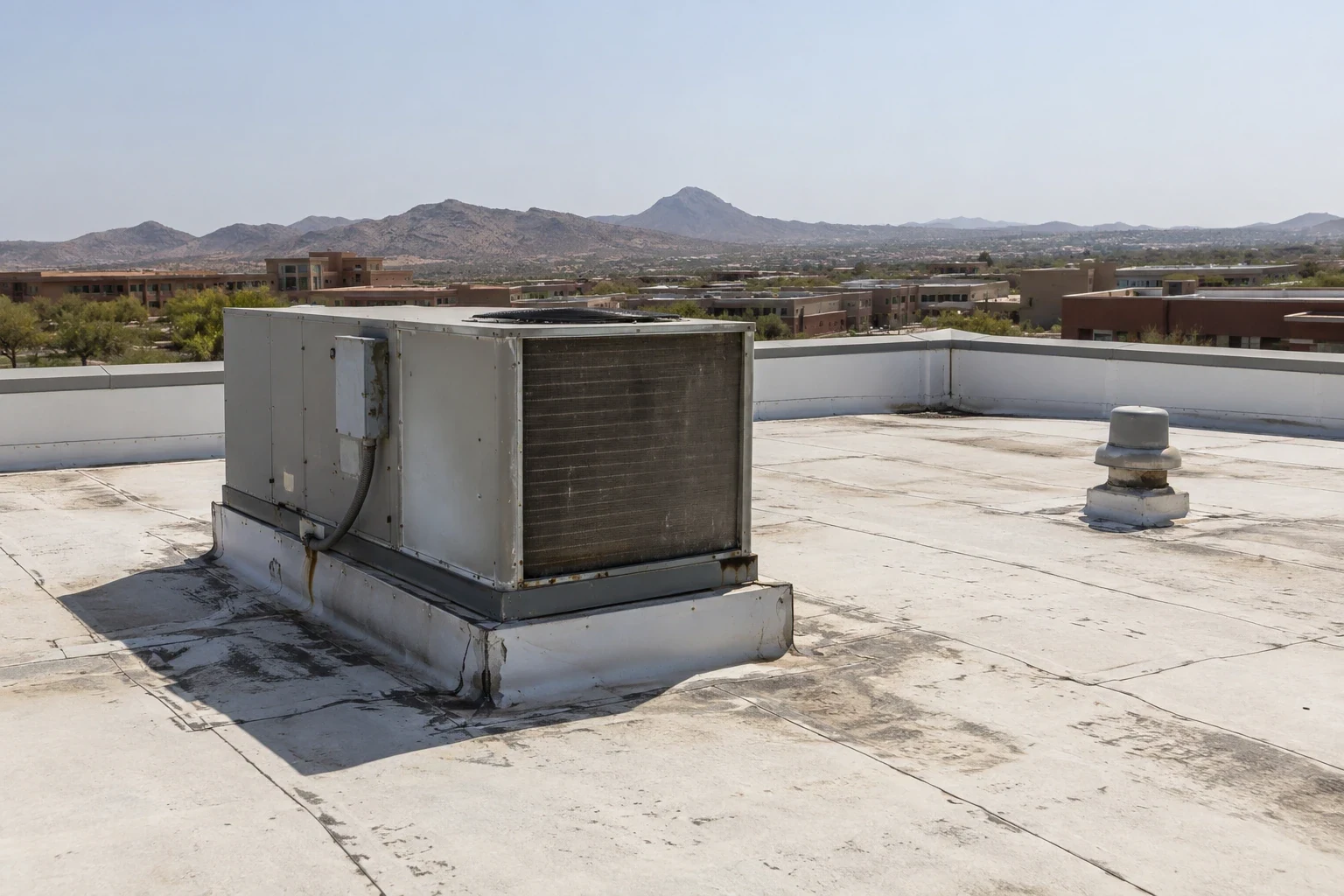
A campus roof portfolio rarely fails all at once. It fails building by building, in a pattern that a good record can predict long before the first ceiling tile drops. A residence hall roof, a laboratory roof and a library roof may share an age and still deserve very different treatment, because the cost of a leak depends on what sits beneath. In Peoria, AZ, heat cycles and monsoon storms work on every campus building, and the October 2010 supercells that crossed the Phoenix metropolitan area show how quickly hail can change a capital plan. We begin with a ranking by use and consequence, then add age and condition, so spending follows risk.
Rank buildings by use before ranking them by age
Age is a poor guide on its own. A newer lab building with a leaking curb may be a bigger problem than an older storage building with a tired membrane. We rate each building on two scales: what a leak would cost and how likely a leak is. Laboratories, archives, data rooms, performance spaces and residential floors score high on consequence.
The combined rating drives the order of surveys, repairs and replacements. Buildings with high consequence and moderate condition may need earlier attention than buildings with poor condition and low consequence. That logic is written into the plan, so the facilities office can explain the order to deans, trustees or a state oversight body.
A written scoring sheet makes the ranking repeatable. Each building receives a consequence score, a condition score and a note on the evidence behind both. When a survey changes a score, the sheet shows why, and the order of work adjusts without a new debate.
Fit the work to the academic calendar
A campus has several quiet periods: summer, winter break and the days between sessions. Each supports a different scale of work. Summer allows tear-off and replacement. Winter break supports shorter projects and repairs. Between sessions, small sections can be closed and tested.
We schedule by building use. Residence halls may be vacant for a defined window, while labs may run year-round. Research spaces with sensitive experiments require additional protection and advance notice. We ask department heads for restricted dates and plan around them, then confirm in writing so no crew arrives during a protected experiment or an exam.
Move-in and move-out weeks deserve special care, since traffic, parking and loading areas fill up and staging space disappears. We keep material deliveries out of those weeks and confirm the plan with housing and event staff.
Athletic and performance venues follow their own calendars, and large events limit crane lifts and overhead work near crowds. Those dates go into the schedule early.
Protect laboratories, archives and equipment rooms
A lab roof carries exhaust fans, fume hoods, ducts and sometimes specialty equipment. The membrane near exhaust can suffer chemical exposure, and the penetrations are numerous. We inspect the area around each exhaust, note staining or softening and check curbs and flashings. Where chemicals are emitted, material selection takes the exposure into account.
Archives and equipment rooms demand water control. Temporary protection, vapor management and rapid response plans are put in place before the roof is opened. Work on rooftop equipment curbs is coordinated with the department's engineer so that nothing is moved or shut down without agreement.
Vibration can matter as much as dust. Some instruments are sensitive to equipment on the roof, so tear-off methods and the timing of heavy tasks are agreed with the lab before the first day.
Use the storm record to guide inspection after severe weather
Supercells that crossed the Phoenix metropolitan area in October 2010 left large hail and extensive damage, and monsoon storms add gusts and flash flooding. For a campus, such events are a reason to document roofs before and after, not proof that a given building was harmed.
After a severe storm, we walk the highest-consequence buildings first. We look for bruised membrane, cracked coatings, displaced edge metal and blocked drains. Findings are recorded building by building, and the pattern shows whether a claim is warranted. A storm damage roof repair can then be scoped by section instead of by guesswork.
A second pass after a storm covers drains, scuppers and rooftop screens, which can catch wind and loosen. Roofs found dry and intact are logged as such, which is as useful for the record as a repair.
Standardize details where buildings share a maintenance team
A campus maintenance team services many roofs. Using a small number of well-chosen systems and details makes repair easier, spare materials simpler and training shorter. We compare TPO, PVC and other options by durability, repairability and cost, and recommend a standard where the buildings allow it.
Exceptions are noted. A historic building, a domed roof or a green roof may need a different approach, and the plan says why. Over time, a standard reduces the number of unknown details and speeds up emergency repairs, since staff know what they are looking at when they reach the roof.
Months of 100-degree afternoons explain why membrane and sealant details move hard through summer. Standard details that tolerate that movement are worth specifying once and repeating.
Run the campus as a program with a single record
A multi-site roof program lists every building, every roof section, its rating and the planned action by year. Updates follow each survey or repair. The same record supports budget requests, insurance reviews and audits. Institutions that also run K-12 schools apply the same ranking to their school roofs, and those with a clinic apply it to a medical office building. For work near Peoria, the shared format keeps every site on the same footing.
Each update carries a date, the surveyor and the evidence, so a new facilities director can see how the plan changed and why.
Peoria's planning for the Loop 303 corridor and the Peoria Innovation Core describes employment growth in advanced manufacturing and semiconductor supply chains, which can shape how an institution adds buildings or training space over time. The roof record should be ready to absorb those additions without starting from scratch.
Commercial Roofing Questions
How should a university prioritize roof work across many buildings?
Rank by the cost of a leak first, then by likelihood. Laboratories, archives, residences and performance spaces rank high on consequence. Combine that with age, moisture data and leak history to set the order, and write the logic down so the plan can be explained to stakeholders.
Can roof work happen during the academic year?
Yes for repairs and small sections, with protected walkways, limited noise and notice to departments. Large replacements fit better into summer or breaks. We coordinate with each department and confirm restricted dates before the schedule is set.
What special concerns apply to laboratory roofs?
Chemical exposure near exhaust, many penetrations and tight tolerance for water inside. We inspect the membrane around each discharge, choose materials that match the exposure and coordinate with the lab's engineer before moving any equipment.
How does a campus handle storm damage claims?
By documenting the roofs before the storm, walking the highest-consequence buildings afterward and recording findings by section. The record separates storm damage from age. It gives the adjuster clear evidence and helps the campus decide what to repair now and what to defer.
Is it worth standardizing roof systems across a campus?
Often yes, where buildings allow it. Fewer systems mean fewer spare parts, simpler training and faster repairs. Exceptions for special buildings are listed with reasons, and the standard is reviewed each time a roof is replaced.