Aircraft Hangar Roofing in Peoria, AZ
The roof edge above a hangar door can leak for months before anyone notices, because the water runs down the header and drips onto the floor outside the aircraft's footprint. A hangar roof is a long span with few penetrations and large doors, so the failures cluster at the edges, the door headers and the transitions to attached offices or shops. In Peoria, AZ, heat cycles and monsoon wind work hardest on those details. The deciding evidence is where water enters, how earlier repairs fared and whether wet insulation or corroded fasteners have spread. Then we draw the repair boundary and talk about timing.
Locate the leak against the hangar door header
Large hangar doors put big openings in a wall, and the roof edge above them has to shed water away from the track, the header and the interior. We inspect the eave, the gutter, the drip edge and the wall flashing at each door, then check the header for staining, rust and daylight.
Wind plays a part. When a door is open, air can pressurize the building and push upward on the roof, so edge details that survive in a closed building can loosen. We look at perimeter fasteners, trim and coping for movement and tighten or replace what has backed out. A leak at the header is rarely a field-of-roof problem, and treating it as one wastes money.
Attached offices, shops and lean-to sections add transitions. Where a low roof meets a high wall, a step flashing or counterflashing takes the load, and we check it for open joints and dried sealant. Those transitions are small in area and large in consequence.
Gutters on a long eave carry a great deal of water in a short burst, so we also check joints, hangers and outlet size along the full run.
Read the long span as a single water path
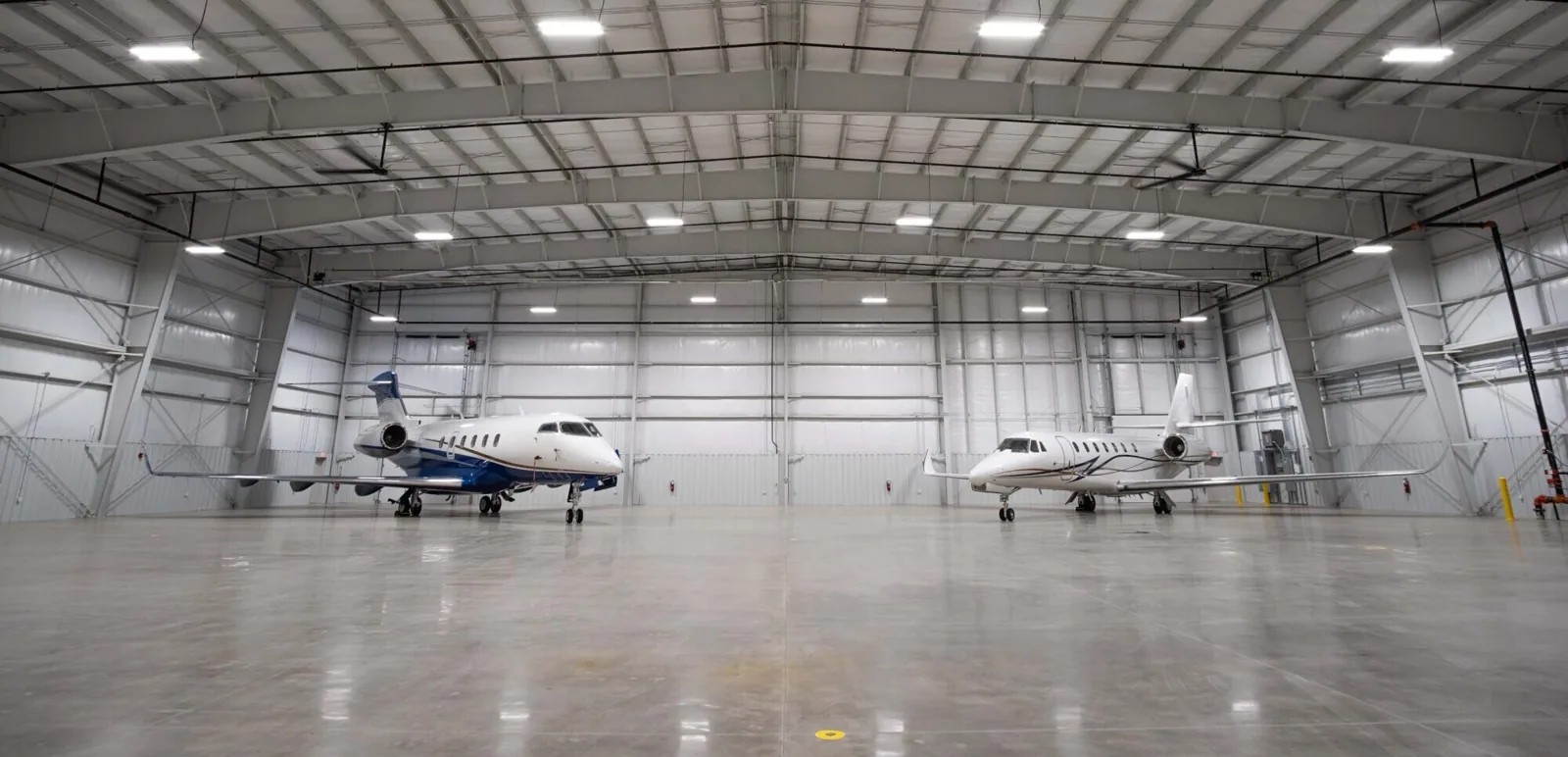
On a large clear-span roof, water crosses a long distance to reach a gutter or drain, and any weakness along that path becomes a leak. We trace the route from the ridge or the high point to the outlet, noting laps, seams, fasteners, penetrations and settled areas.
Standing water on a low-slope hangar roof is a warning. The cause may be slope, drainage or deck deflection, and each cause needs its own correction. Clogged gutters and downspouts are the easiest to address. Slope problems may need tapered insulation during a recover. Deck deflection goes to an engineer before membrane work begins. Our roof drain and scupper checks keep outlets clear and record flow.
Inspection from above is only half of it. We also look at purlins and framing from below, where the building allows, for rust streaks, drip marks and condensation, because moisture that never reaches the floor can still corrode structure and insulation.
Keep aircraft and equipment protected while the roof is open
Aircraft, tools and test equipment cannot sit under an open roof. We agree on protection with the facility manager before work starts: aircraft moved or covered, floor areas masked, drip catchers placed under any exposed deck and a dry-in plan for every opened section. We phase the job bay by bay, which keeps the remainder of the hangar in service.
Debris control matters as well. Fasteners, metal shavings and old sealant can damage aircraft surfaces or be pulled into equipment, so we use magnetic sweeps, covered containers and daily cleanup. A hangar roof job is scheduled around the aircraft in it, not the other way around, and the manager gets the plan in writing.
Fuel, solvent and hydraulic fluid are outside our scope but inside the hangar, so we confirm with the manager which areas are restricted and what ignition controls apply to hot work.
Heat and storms set the calendar. About 94 days a year reach 100°F around Phoenix, a figure that frames the heat cycle on metal and sealant, and NWS monsoon guidance lists damaging winds and microbursts among the storm hazards. A hangar owner in the Peoria market near Loop 303 or Loop 101 can use those facts to time inspections ahead of storm season, not to presume damage.
Compare metal panel, membrane, and coating on the span
Hangar roofs commonly use metal panels or a membrane over metal deck, and the repair follows the system. Standing seam metal needs attention at clips, panel ends and trim. A membrane needs seam and flashing checks. A coating can extend the life of a sound surface but cannot fix corroded panels or wet insulation.
We sample and identify each section, probe for moisture and rate it. The comparison depends on span, access, aircraft schedule and remaining service life. Sound panels may justify a coating, worn panels over good framing may justify a retrofit and repeated failures may justify replacement. The scope names the reason for the choice.
A flex industrial building with a hangar-like bay raises the same questions about span and door edges, so the same checklist applies.
Cost follows span, access, panel type, insulation, crane or lift needs and how much of the hangar must stay in use. We price bays separately where the schedule allows so the owner can phase work.
Plan access around suppression, lighting, and the regional mix
Hangars often have overhead fire suppression, lighting and cranes hung from the structure, so roof fasteners and attachment points must avoid them. Where the building allows, we trace those systems from underneath and mark off-limits zones before a single fastener is set.
The Peoria region also contains aviation-related buildings on a larger scale. Luke Air Force Base lies roughly 17 miles southwest of Peoria and is home to the 56th Fighter Wing and its fighter squadrons, while Goldwater Air National Guard Base in Phoenix reports eight KC-135 aircraft. Those installations bring aircraft-support buildings into the regional picture, and the military hangar and maintenance facility and Air Force base buildings of that kind follow their own access rules, though none of this says anything about a specific roof. Our military installation roofing approach covers access and escort when a project calls for it.
Commercial Roofing Questions
Why do hangar roofs often leak near the doors?
The door opening interrupts the wall, so the eave and header carry extra flashing and trim. Wind pressure with the door open can also loosen edge details. We inspect the gutter, drip edge, header and fasteners together and repair the specific failing piece.
How do you protect an aircraft during a roof repair?
The aircraft is moved or covered, the floor below is masked and drip catchers go under any exposed deck. Work is phased by bay, and debris is controlled with magnetic sweeps and covered containers. The manager receives the plan before work begins.
What is the best way to compare a coating with a replacement?
Check panel condition, fastener condition and moisture first. If panels are sound and insulation is dry, a coating can extend service life. If panels are corroded or insulation is wet, replacement is the better value. We show the readings and cost of each path.
Does standing water on a hangar roof mean the roof has failed?
It means something is holding water. The cause may be a blocked outlet, a slope problem or deck deflection. We measure depth, trace the path and name the cause before recommending a repair, since each cause needs a different fix.
What records should a hangar owner keep after roof work?
Keep photographs, a section map, moisture readings, product information and any warranty file. Add the dates and the location of each repair. That asset record helps the next inspection and supports an insurer or a buyer.